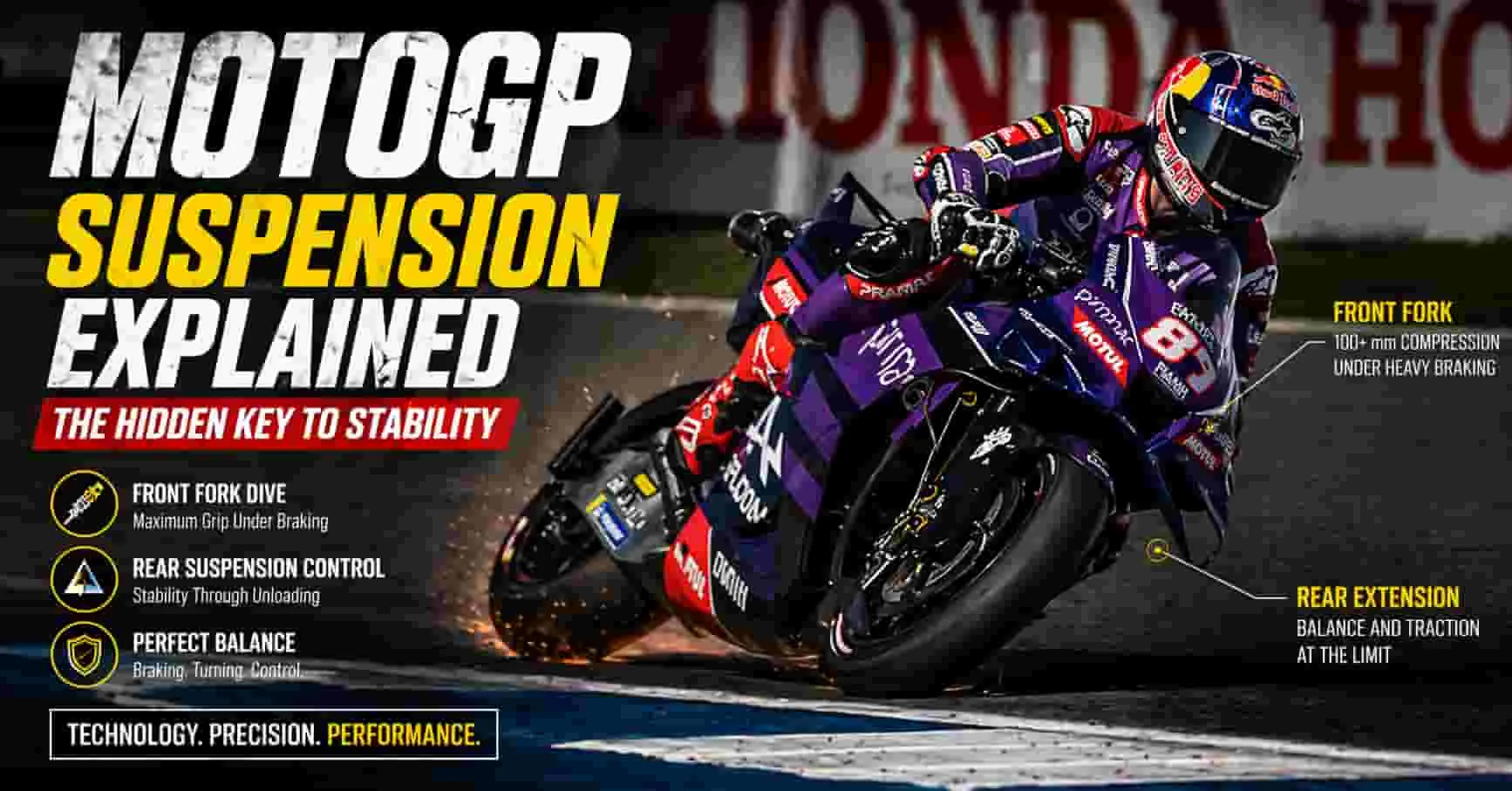
MotoGP suspension explained begins with a fundamental reality: braking performance is not limited by brakes alone—it is controlled by how effectively the suspension manages load transfer. When a rider decelerates from over 300 km/h to below 100 km/h, the forces acting on the bike are immense, reaching 1.5–1.7G.
In this phase, suspension determines:
- How quickly weight shifts forward
- How consistently the front tire maintains grip
- How stable the bike remains during corner entry
To understand how MotoGP suspension works under braking, we need to analyze the interaction between load transfer, damping, geometry, and tire behavior.
The Core Role of Suspension: Managing Load Transfer
Under braking, weight moves forward aggressively.
What Happens:
- 80–90% of total load shifts to the front tire
- Front forks compress rapidly
- Rear suspension extends and unloads
Why It Matters:
- Front tire gains grip
- Rear tire becomes unstable
Key Insight:
Suspension does not stop load transfer—it controls the rate and stability of that transfer.
Front Suspension: Controlling Dive and Maximizing Grip
The front forks are the most critical component during braking.
Key Functions:
- Absorb forward load
- Maintain tire contact
- Stabilize steering
Technical Parameters:
- Fork travel: ~80–120 mm under heavy braking
- Compression damping: controls dive speed
- Spring stiffness: controls total compression
Performance Balance:
- Too soft → excessive dive, instability
- Too stiff → reduced front grip
Key Insight:
Optimal front suspension allows maximum tire contact without overwhelming the chassis.
Embed from Getty Images
Rear Suspension: Stability Through Unloading
While the front gains load, the rear must maintain balance.
What Happens:
- Rear suspension extends
- Load on rear tire decreases
Challenges:
- Rear instability
- Increased tendency to slide
Key Role:
- Maintain chassis stability
- Prevent excessive pitch movement
Geometry Changes Under Braking
Suspension movement alters bike geometry.
Key Changes:
- Reduced rake angle
- Reduced trail
Effect:
- Faster steering response
- Increased sensitivity
Key Insight:
Suspension is not just absorbing forces—it is actively reshaping the bike’s handling characteristics.
Damping: The Hidden Performance Lever
Damping determines how the suspension behaves dynamically.
Types:
- Compression damping: controls how fast the fork compresses
- Rebound damping: controls how it returns
Why It Matters:
- Prevents sudden weight transfer
- Keeps tires in consistent contact
Key Insight:
Damping smooths the transition between:
- Braking
- Corner entry
- Lean angle changes
Embed from Getty Images
Suspension and Tire Contact: The Critical Link
Grip depends on maintaining a stable contact patch.
Under Braking:
- Front tire experiences extreme load
- Suspension must keep contact consistent
Key Insight:
Even small inconsistencies in suspension movement can:
- Reduce grip
- Increase braking distance
Trail Braking: Where Suspension Is Most Tested
Trail braking combines braking and cornering forces.
What Happens:
- Fork remains partially compressed
- Lean angle increases
- Load shifts dynamically
Challenge:
- Maintain stability while turning
Key Insight:
Suspension must handle combined longitudinal and lateral forces simultaneously.
The Metrics: Suspension Performance Under Braking
| Parameter | Typical Value |
|---|---|
| Deceleration | ~1.5–1.7G |
| Fork Travel | ~80–120 mm |
| Front Load Transfer | ~80–90% |
| Brake Pressure | ~100–130 bar |
Case Study: Francesco Bagnaia vs Marc Márquez
Bagnaia:
- Smooth braking inputs
- Stable suspension behavior
- Consistent front grip
Márquez:
- Aggressive braking
- Greater fork compression variation
- Uses dynamic instability
Insight:
Different styles—but both rely heavily on suspension tuning to extract performance.
Embed from Getty Images
Why Suspension Defines Braking Performance
Suspension directly affects:
- Tire grip consistency
- Stability under load
- Corner entry control
Key Insight:
Without precise suspension behavior:
- Braking distances increase
- Control decreases
- Lap time suffers
The Bigger Picture: Controlled Load Management
MotoGP suspension is about managing extreme forces with precision.
- Too much movement → instability
- Too little movement → reduced grip
Key Principle:
The fastest setup is not the stiffest or softest—it is the most balanced under dynamic load.
Final Insight
MotoGP suspension explained ultimately comes down to one principle:
👉 Suspension controls how force is delivered to the tire—and that defines grip, stability, and performance
It is the unseen system that allows riders to brake later, carry more speed into corners, and maintain control at the absolute limit.
In MotoGP, suspension is not just a mechanical component—it is the foundation of performance under braking.
What is MotoGP suspension?
MotoGP suspension is a high-performance system that controls how the bike manages load, maintains tire contact, and stays stable under braking, acceleration, and cornering.
How does MotoGP suspension work under braking?
Under braking, the front suspension compresses while the rear extends. This controls weight transfer and helps maintain front tire grip and overall stability.
Why do MotoGP bikes have front fork dive?
Front fork dive happens because braking shifts weight forward, compressing the suspension to increase front tire grip.
What is damping in MotoGP suspension?
Damping controls how fast the suspension compresses and rebounds, ensuring smooth weight transfer and consistent tire contact.
How much does MotoGP suspension compress under braking?
Front suspension can compress around 80–120 mm under heavy braking conditions.
Why is suspension important in MotoGP?
Suspension is critical because it directly affects grip, stability, braking performance, and corner entry speed.
