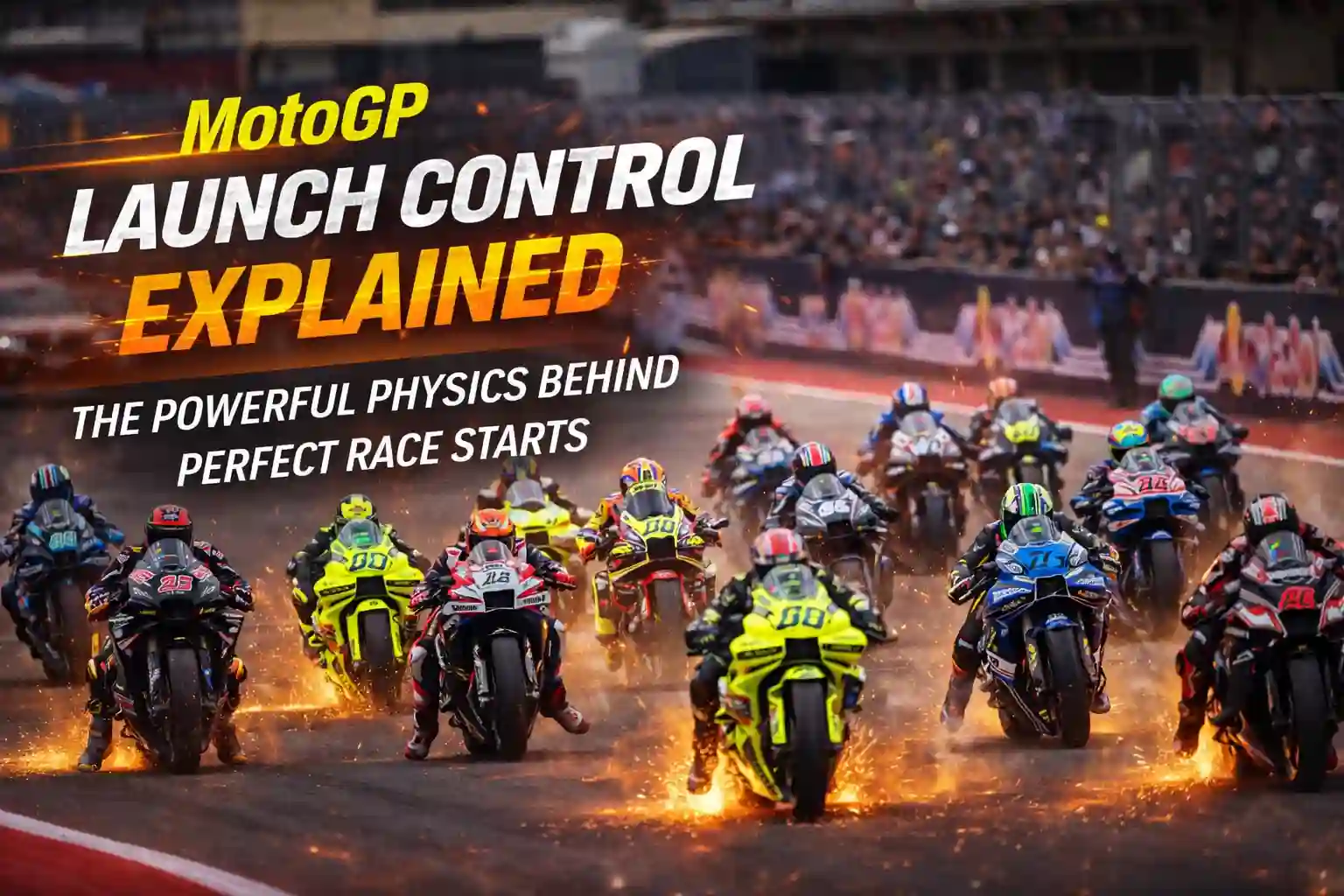
MotoGP launch control explained begins with a simple truth: the first 100 meters of a race can define the final result. In modern MotoGP, riders can gain or lose 3–6 positions before Turn 1, purely based on how effectively they manage traction, clutch input, and electronic assistance at the start.
To understand how MotoGP launch control works, you need to look beyond the electronics and into the physics of acceleration—where rear tire grip, torque delivery, and weight transfer all interact within a fraction of a second.
The Core Challenge: Acceleration vs Grip
At the start, MotoGP bikes are not limited by engine power—they are limited by traction.
What Happens at Launch:
- The rider releases the clutch
- Engine torque is transferred to the rear wheel
- The tire deforms to generate grip
The Limiting Factor:
- Too much torque → wheelspin
- Too little torque → slow acceleration
Optimal Condition:
- Slip ratio of ~5–10% delivers maximum traction
Key Insight:
The fastest start is not the most aggressive—it is the most controlled.
Embed from Getty Images
What Launch Control Actually Does
Launch control is an electronic system designed to optimize acceleration from a standstill.
Core Functions:
- Regulates engine torque output
- Controls throttle response
- Manages rear wheel slip
How It Works:
- Limits power delivery at low speeds
- Prevents excessive wheelspin
- Maintains optimal traction window
Important Detail:
Launch control does not fully automate the start—it works in combination with rider input.
The Role of the Clutch: Where Starts Are Won
Despite advanced electronics, the clutch remains the most critical element.
Why:
- It controls how torque is introduced to the rear tire
- Determines initial traction conditions
Technique:
- Riders “feather” or slip the clutch
- Gradually increase engagement
Data Insight:
A poorly executed clutch release can cost:
- ~0.1–0.3 seconds instantly
Key Insight:
Launch control manages power—but the rider controls the delivery.
Weight Transfer and Load Dynamics
As the bike accelerates:
- Weight shifts to the rear
- Front wheel becomes lighter
- Risk of wheelie increases
Physics:
- Torque creates a rotational moment
- Lifts the front wheel
Problem:
- Wheelie reduces forward acceleration
- Limits usable power
Embed from Getty Images
Anti-Wheelie Systems and Rider Input
To counter wheelies, MotoGP uses:
Electronics:
- Anti-wheelie control reduces torque
Rider Technique:
- Leaning forward
- Controlling throttle
Key Balance:
- Too much suppression → slower acceleration
- Too little → excessive wheelie
The Holeshot Device: Mechanical Advantage
The holeshot device is a mechanical system used to enhance launches.
Function:
- Lowers rear ride height
- Reduces wheelie tendency
- Improves stability
Performance Benefit:
- Allows earlier full throttle
- Improves traction efficiency
Estimated Gain:
- ~0.1–0.2 seconds at launch
Reaction Time: The Human Variable
Even with perfect systems, reaction time is critical.
Typical Range:
- ~0.2–0.3 seconds
Impact:
- Faster reaction = immediate advantage
- Slower reaction = instant position loss
Key Insight:
Starts are one of the few areas where pure human reflex still dominates.
Embed from Getty Images
The Metrics: What Defines a Perfect Launch
| Parameter | Ideal Value |
|---|---|
| Reaction Time | ~0.2–0.3s |
| Slip Ratio | ~5–10% |
| Acceleration | ~1.2–1.4G |
| 0–200 km/h | ~5–6s |
| Wheelie Control | Minimal lift |
Case Study: Jorge Martín vs Francesco Bagnaia
Martín:
- Aggressive clutch release
- Optimized torque delivery
- Gains positions consistently
Bagnaia:
- Smoother, more controlled starts
- Focus on stability
Outcome:
- Martín often gains 2–4 positions at launch
- Bagnaia relies on race pace later
Why Launch Control Is More Important Than Ever
1. Aerodynamic Sensitivity
- Clean air improves performance
- Early position matters
2. Limited Overtaking Opportunities
- Harder to pass mid-race
- Starts become decisive
3. Sprint Race Format
- Shorter races increase start importance
Embed from Getty Images
The Chain Reaction: Start to Finish
A strong launch leads to:
- Better track position
- Cleaner airflow
- Reduced tire wear
- Faster lap times
Data Insight:
Gaining just 3 positions at the start can translate to:
- ~0.5–1.0 seconds advantage in early laps
The Bigger Picture: Controlled Aggression
The perfect launch requires balancing:
- Maximum torque
- Optimal traction
- Minimal wheelie
- Precise timing
Key Insight:
Too aggressive = wheelspin or wheelie
Too conservative = lost positions
Final Insight
MotoGP launch control explained ultimately reveals that the start is not about raw power—it is about how efficiently that power is applied.
Electronics provide the framework, but the rider’s control determines the outcome.
- Launch control manages torque
- The clutch controls delivery
- Physics defines limits
- The rider executes everything
In MotoGP, the race doesn’t just begin when the lights go out—it is often decided in the first few seconds, where precision meets physics at full throttle.
What is MotoGP launch control?
MotoGP launch control is an electronic system that helps riders optimize acceleration at the start by controlling engine power and rear wheel traction.
How does MotoGP launch control work?
MotoGP launch control works by limiting torque delivery and managing wheelspin to keep the rear tire within the optimal grip range during acceleration.
Do MotoGP riders rely entirely on launch control?
No. While launch control assists with traction, the rider still controls the clutch, throttle, and body position, making skill a major factor.
Why is the start so important in MotoGP?
The start is critical because riders can gain or lose multiple positions in the first few seconds, which directly affects race outcome.
What is the ideal slip ratio at a MotoGP start?
The ideal slip ratio is around 5–10%, which provides maximum traction without excessive wheelspin.
What is the holeshot device in MotoGP?
The holeshot device lowers the bike’s rear suspension during the start to reduce wheelies and improve acceleration.
