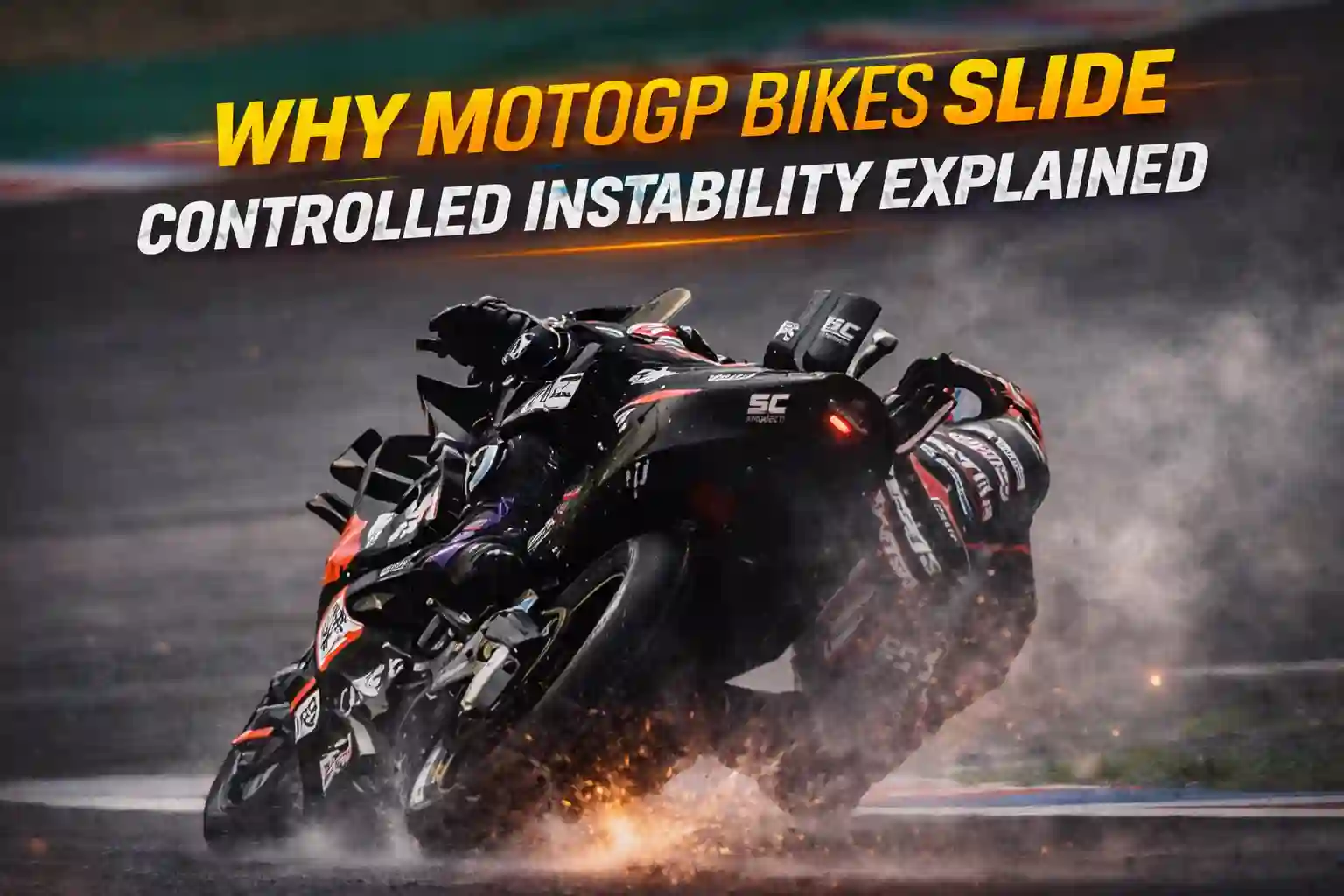
Why MotoGP bikes slide is one of the most misunderstood aspects of elite motorcycle racing. What appears to be a loss of control is, in reality, a deliberate and highly controlled technique used to improve corner entry speed and reduce lap time.
At speeds exceeding 300 km/h into braking zones, riders intentionally induce rear tire slip to rotate the bike faster. To understand this fully, we need to explore how MotoGP riders control rear slide using physics, braking dynamics, and precise inputs.
The Core Principle: Controlled Instability Creates Speed
In conventional riding, stability equals safety. In MotoGP, however:
👉 A controlled loss of rear grip can improve performance
By allowing the rear tire to slide slightly:
- The bike rotates toward the apex
- Steering effort is reduced
- Corner entry becomes faster
Key Insight:
A small, controlled slide is faster than perfect stability.
The Physics of Corner Entry
Corner entry is governed by the balance between:
- Longitudinal forces (braking)
- Lateral forces (cornering)
- Tire grip limits (friction circle)
Under Heavy Braking:
- Up to 80–90% of weight shifts to the front tire
- Rear tire load decreases significantly
- Rear grip becomes limited
Result:
The rear tire is more likely to exceed its grip threshold—initiating a slide.
Embed from Getty Images
Trail Braking: The Trigger Mechanism
Trail braking is essential to initiating rear slides.
What Happens:
- Rider maintains front brake pressure into the corner
- Lean angle increases
- Rear load decreases further
Outcome:
- Rear tire exceeds grip limit slightly
- Controlled slide begins
Data Insight:
- Rear slip angle: ~5–8° during optimal slide
Rear Slip Angle: The Key Performance Metric
The rear tire does not follow the exact direction of travel.
Definition:
- Slip angle = difference between tire direction and movement
Optimal Range:
- 5–8° → controlled rotation
- Above ~10° → instability risk
Key Insight:
Maximum performance occurs at controlled slip—not zero slip.
How Sliding Improves Rotation
When the rear slides outward:
- The bike pivots around the front tire
- Yaw angle increases
- Direction change becomes faster
Performance Benefit:
- Reduced steering input
- Faster alignment with corner exit
Time Gain:
- ~0.05–0.1 seconds per corner
Embed from Getty Images
Engine Braking: A Key Contributor
Engine braking plays a major role in rear slide behavior.
What It Does:
- Adds braking force through the rear wheel
- Increases slip tendency
Electronics:
- Engine braking maps regulate intensity
- Prevent excessive locking
Key Balance:
- Too aggressive → instability
- Too mild → reduced rotation
How MotoGP Riders Control Rear Slide
Understanding how MotoGP riders control rear slide is key to this technique.
Rider Inputs:
- Front brake modulation → maintains front grip
- Rear brake control → stabilizes slide
- Throttle blips → adjust engine braking
- Body position → shifts load forward
Key Principle:
- Front tire provides stability
- Rear tire enables rotation
The Risk Window: Where It Goes Wrong
This technique operates at the limit of grip.
Potential Failures:
- Excess slip → loss of control
- Sudden grip regain → highside crash
- Front overload → lowside
Key Insight:
There is a very narrow margin between:
- Optimal slide
- Crash
Embed from Getty Images
Case Study: Marc Márquez vs Brad Binder
Márquez:
- Aggressive rear slides
- Maximizes rotation
- High risk, high reward
Binder:
- Controlled, minimal slide
- Focus on stability
Insight:
Both approaches rely on the same physics—but differ in risk tolerance.
Tire Behavior: Why Sliding Is Possible
MotoGP tires are designed to operate under slip.
Key Properties:
- Progressive grip loss
- Predictable response
- High-temperature operation (~100–120°C)
Key Insight:
Tires do not instantly lose grip—they allow controlled sliding.
Why This Matters for Lap Time
Corner entry directly influences:
- Apex speed
- Corner exit positioning
- Overall lap efficiency
Key Insight:
Faster rotation = earlier throttle application = faster lap time
The Metrics: Sliding vs Performance
| Factor | Effect on Lap Time |
|---|---|
| Controlled slide | +0.05–0.1s gain per corner |
| Excess slide | Time loss + instability |
| No slide | Slower rotation |
The Bigger Picture: Controlled Chaos
MotoGP performance is built on managing instability—not eliminating it.
- Stability limits rotation
- Controlled instability enables direction change
Key Principle:
The fastest riders operate in a zone where:
- The bike is slightly unstable
- But fully controlled
Final Insight
Why MotoGP bikes slide comes down to a single principle:
👉 A controlled rear slide allows faster rotation and better corner entry performance
By intentionally operating at the limit of rear grip, riders:
- Improve direction change
- Reduce steering input
- Gain valuable lap time
In MotoGP, perfection is not about eliminating instability—it is about controlling it with precision.
Why do MotoGP bikes slide on corner entry?
MotoGP bikes slide on corner entry because riders intentionally reduce rear tire grip under braking to help rotate the bike faster toward the apex.
Is sliding in MotoGP intentional?
Yes, the rear slide is controlled and deliberate. Riders use it as a technique to improve corner entry speed and positioning.
What is “backing it in” in MotoGP?
“Backing it in” is a technique where the rear wheel slides outward under braking, helping the bike rotate into the corner more efficiently.
Does sliding make MotoGP bikes faster?
Yes, when controlled properly, sliding reduces steering effort, improves rotation, and can save valuable time in each corner.
What is slip angle in MotoGP?
Slip angle is the difference between the direction the tire is pointing and the direction it is actually moving. Controlled slip angles help maximize performance.
What happens if the slide becomes too large?
If the rear slide exceeds the optimal range, it can lead to loss of control or a crash, especially if grip suddenly returns.
