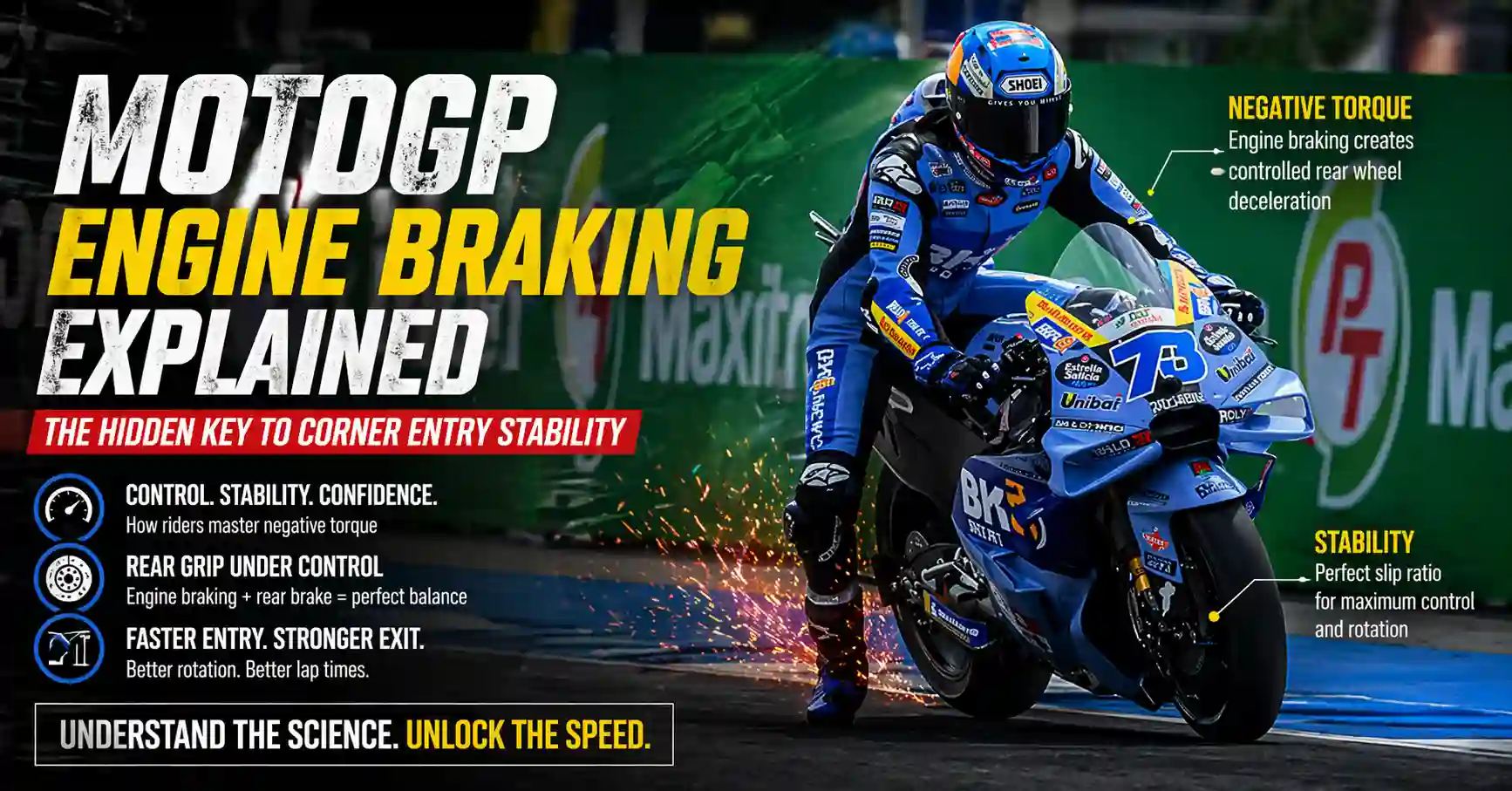
MotoGP engine braking explained starts with a reality most fans underestimate: a significant portion of deceleration in MotoGP comes from the engine itself—not just the brakes. When riders shut the throttle at over 300 km/h, the engine produces negative torque that directly influences rear wheel behavior.
This is not just about slowing down. It’s about controlling rear grip, managing stability, and shaping how the bike enters a corner. Understanding why engine braking is important in MotoGP reveals one of the most critical performance tools in modern racing.
What Engine Braking Really Is
Engine braking occurs when the throttle is closed and the engine resists rotation.
What Happens Mechanically:
- Throttle closes → airflow is restricted
- Engine compression increases resistance
- Rear wheel experiences negative torque
Effect:
- Deceleration is applied through the rear wheel
- Load shifts forward
- Rear tire becomes sensitive to slip
Key Insight:
Engine braking is not passive—it is an active performance tool.
The Physics: Rear Wheel Deceleration and Grip
Under braking, forces must stay within the tire’s grip limit.
During Deceleration:
- Front tire handles 80–90% of load
- Rear tire becomes lightly loaded
- Grip margin at the rear is reduced
Critical Metric:
- Rear slip ratio (~5–10%) → optimal performance
Too Much Engine Braking:
- Rear wheel slows excessively
- Slip increases beyond optimal range
- Instability or lock-up
Too Little:
- Reduced rotation
- Slower corner entry
Key Insight:
The goal is controlled slip—not eliminating it.
Why Engine Braking Is Important in MotoGP
Engine braking influences multiple performance areas simultaneously.
1. Rear Stability
- Prevents uncontrolled rear movement
- Helps maintain balance under heavy braking
2. Corner Entry Rotation
- Slight rear slip helps rotate the bike
- Reduces steering input
3. Braking Efficiency
- Shares deceleration load with front brakes
- Improves overall braking performance
Key Insight:
Engine braking connects braking and cornering into one continuous phase.
Embed from Getty Images
Engine Braking Maps: Electronic Precision
Modern MotoGP bikes use sophisticated ECU-controlled maps.
What They Control:
- Level of negative torque
- Rate of engine braking application
- Behavior across RPM ranges
Why This Matters:
- Prevents sudden rear wheel deceleration
- Maintains predictable slip
Rider Control:
- Adjustable per corner
- Adapted to track grip and tire wear
Key Insight:
Electronics refine engine braking—but riders still manage its limits.
The Slipper Clutch: Mechanical Backup
Before advanced electronics, the slipper clutch was essential.
Function:
- Allows clutch slip under high deceleration
- Prevents rear wheel lock
Modern Role:
- Works alongside ECU maps
- Provides mechanical safety
Rear Brake vs Engine Braking
Riders combine engine braking with rear brake input.
Engine Braking:
- Creates deceleration
- Initiates rear slip
Rear Brake:
- Stabilizes rear wheel
- Fine-tunes slip
Key Insight:
Rear brake is not for stopping—it’s for control and balance.
Embed from Getty Images
Corner Entry Sequence: Step-by-Step
A typical corner entry involves:
- Heavy front braking
- Throttle closure → engine braking begins
- Rear tire unloads
- Controlled slip develops
- Rider modulates inputs
Result:
- Smooth transition into lean
- Optimized corner entry speed
The Risk Window: Precision Required
Operating near the limit introduces risk.
Too Aggressive:
- Rear chatter
- Loss of stability
- Crash potential
Too Conservative:
- Reduced rotation
- Slower lap time
Key Insight:
Engine braking operates within a very narrow optimal window.
Case Study: Marc Márquez vs Francesco Bagnaia
Márquez:
- Aggressive engine braking
- More rear instability
- Maximizes rotation
Bagnaia:
- Smoother engine braking maps
- Stable rear behavior
- Consistent entry
Insight:
Different styles—but both depend on precise engine braking control.
The Metrics: Engine Braking Performance
| Parameter | Typical Value |
|---|---|
| Deceleration | ~1.5–1.7G |
| Rear Slip Ratio | ~5–10% |
| Speed Reduction | 250+ km/h |
| Brake Pressure | ~100–130 bar |
Embed from Getty Images
How Engine Braking Shapes Lap Time
Engine braking directly affects:
- Corner entry speed
- Bike rotation
- Stability under braking
Key Insight:
Better control → earlier throttle → faster exit
The Bigger Picture: Integrated Braking System
MotoGP braking is not a single system—it is a combination of:
- Front brakes
- Engine braking
- Rear brake
- Rider input
Key Principle:
Maximum performance comes from balance between all elements.
Final Insight
MotoGP engine braking explained ultimately comes down to this:
👉 Engine braking is a precision tool used to control rear grip, stabilize the bike, and optimize corner entry
It is not just about slowing the bike—it is about shaping how the bike behaves at the most critical phase of the lap.
In MotoGP, the difference between stability and instability is measured in milliseconds—and engine braking is one of the key tools that defines that boundary.
What is engine braking in MotoGP?
Engine braking in MotoGP is the deceleration force created when the rider closes the throttle, causing the engine to resist rotation and slow the rear wheel.
Why is engine braking important in MotoGP?
Engine braking is important because it helps control rear wheel stability, improves corner entry, and supports overall braking performance.
What are engine braking maps in MotoGP?
Engine braking maps are electronic settings that control how much negative torque the engine produces when the throttle is closed.
What happens if engine braking is too strong?
Too much engine braking can cause rear wheel instability, chatter, or even loss of control.
What happens if engine braking is too weak?
Too little engine braking reduces bike rotation and can make corner entry slower and less efficient.
How does engine braking affect corner entry?
Engine braking helps control rear wheel slip, allowing the bike to rotate more effectively into the corner.
