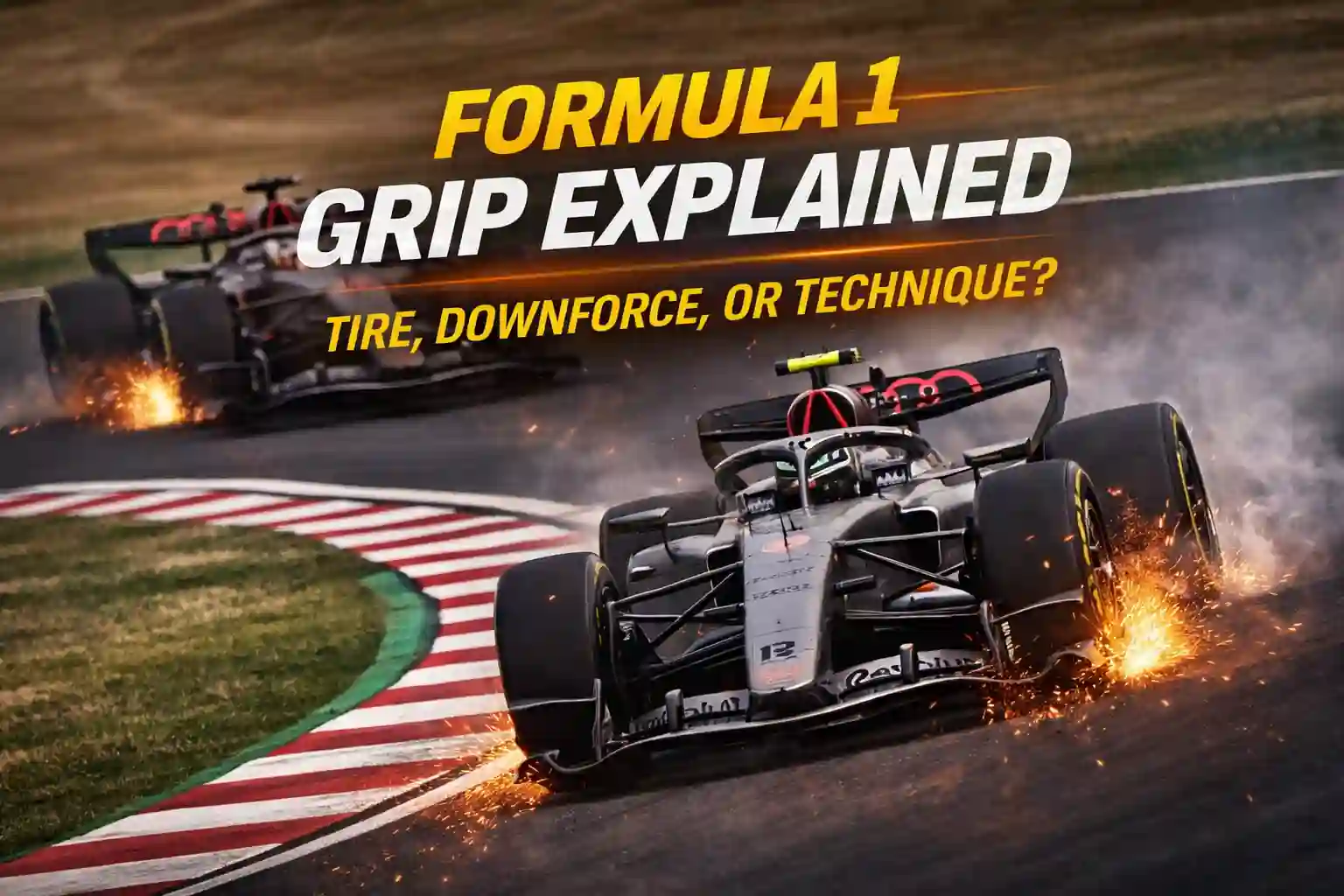
Formula 1 grip explained begins with a fundamental reality: every millisecond of lap time is governed by how effectively a car can generate and sustain grip. At speeds exceeding 250 km/h, F1 cars experience lateral forces of 4–5G, pushing both machinery and driver to the physical limit.
To understand what actually creates grip in Formula 1 racing, you need to examine three interconnected systems:
- Tires (mechanical grip)
- Aerodynamics (downforce)
- Driver technique (grip utilization)
None of these operate in isolation. The fastest cars are those that balance all three with precision.
Mechanical Grip: The Foundation of Performance
Tires are the only contact between the car and the track. Everything—braking, acceleration, cornering—depends on this small interface.
Key Characteristics:
- Contact patch roughly the size of a hand
- Operating temperature: 90–110°C
- Grip influenced by load and slip angle
How Tires Generate Grip:
- Adhesion – chemical bonding with the surface
- Deformation – rubber conforming to track texture
Data Insight:
- Peak grip occurs at a slip angle of ~4–7°
- Beyond this range, grip falls off sharply
Key Insight:
Mechanical grip defines performance in:
- Low-speed corners
- Traction zones
- Braking phases
Aerodynamic Grip: Downforce as a Multiplier
Downforce is what allows F1 cars to corner at extreme speeds.
What Downforce Does:
- Pushes the car into the track
- Increases vertical load on tires
- Enhances available grip
Key Metrics:
- Downforce can exceed 2–3× the car’s weight at high speed
- Grip increases with load—but not linearly
Critical Advantage:
Unlike mass, downforce:
- Does not increase inertia
- Only increases tire loading
Speed Dependency: Why Grip Changes Constantly
Grip in Formula 1 is not static—it changes with speed.
Low-Speed Corners:
- Minimal aerodynamic effect
- Mechanical grip dominates
High-Speed Corners:
- Downforce becomes the dominant factor
- Massive grip increase
Key Insight:
This is why F1 cars:
- Struggle in slow corners
- Excel in high-speed sections
Driver Technique: Extracting Maximum Grip
Even with perfect tires and aero, grip must be used correctly.
Key Inputs:
- Steering angle
- Throttle application
- Brake pressure
Driving Principles:
- Smooth inputs maintain grip
- Aggressive inputs overload tires
Data Insight:
- Abrupt throttle can raise tire temperature by +5–10°C
- Leads to grip loss and faster degradation
Key Insight:
Driver technique determines how much of the available grip is actually used.
The Grip Triangle: How It All Connects
| Factor | Role | Dependency |
|---|---|---|
| Tires | Generate base grip | Temperature, load |
| Downforce | Increase available grip | Speed |
| Technique | Utilize grip effectively | Driver skill |
Key Insight:
Maximum performance occurs when all three are balanced.
Corner Analysis: Where Grip Comes From
Low-Speed Corners (Hairpins)
- Mechanical grip dominant
- Driver input critical
- Aero influence minimal
Medium-Speed Corners
- Balanced contribution
- Tire + aero interaction
High-Speed Corners
- Downforce dominant
- Massive vertical load
- Precision still required
The Metrics: Translating Grip Into Lap Time
| Performance Factor | Lap Time Gain |
|---|---|
| Optimal tire temperature | +0.1–0.2s per lap |
| Improved aero efficiency | +0.2–0.4s per lap |
| Smooth driver inputs | +0.1–0.3s per lap |
Key Insight:
Small improvements across all areas compound into significant gains.
Case Study: Max Verstappen vs Lewis Hamilton
Verstappen:
- Aggressive rotation
- Higher slip angles
- Maximizes entry grip
Hamilton:
- Smooth inputs
- Preserves tire life
- Consistent grip usage
Insight:
Different approaches—but both optimize the same grip principles.
Tire Temperature: The Hidden Performance Factor
Grip depends heavily on temperature.
Optimal Window:
- 90–110°C
Outside This Range:
- Too cold → reduced grip
- Too hot → overheating and degradation
Key Insight:
Temperature control is essential for maintaining performance.
Load Sensitivity: The Non-Linear Reality
Tires are load-sensitive.
What This Means:
- Increasing load increases grip—but not proportionally
- Efficiency decreases at higher loads
Implication:
- Too much downforce can overload tires
- Balance is critical
Dirty Air: The Hidden Grip Killer
When following another car:
- Airflow becomes turbulent
- Downforce is reduced
- Grip decreases
Impact:
- Reduced cornering speed
- Increased tire overheating
Key Insight:
Aerodynamic grip is highly sensitive to airflow quality.
The Bigger Picture: Efficiency Over Maximums
The fastest cars are not those with:
- The most downforce
- The softest tires
They are the ones that:
- Maintain optimal balance
- Use grip efficiently
- Avoid exceeding limits
Final Insight
Formula 1 grip explained ultimately comes down to interaction:
- Tires create grip
- Downforce amplifies it
- Drivers control how it is used
No single factor dominates in isolation. Performance emerges from how well these elements are integrated.
At the limit, grip is not just about how much you have—it’s about how effectively you manage it over an entire lap.
What creates grip in Formula 1?
Grip in Formula 1 is created by a combination of tires, aerodynamic downforce, and driver technique working together to maximize traction and control.
What is mechanical grip in F1?
Mechanical grip comes from the tires and suspension system. It depends on tire compound, temperature, and how the car transfers load to the track.
What is aerodynamic grip in Formula 1?
Aerodynamic grip is generated by downforce, which pushes the car into the track and increases tire contact, especially at high speeds.
Why do F1 cars have more grip at high speed?
At higher speeds, downforce increases significantly, adding more load to the tires and improving overall grip.
What is the ideal tire temperature in Formula 1?
What is the ideal tire temperature in Formula 1?
What is slip angle in F1?
Slip angle is the angle between the tire’s direction and its actual path. Maximum grip usually occurs at around 4–7 degrees.
