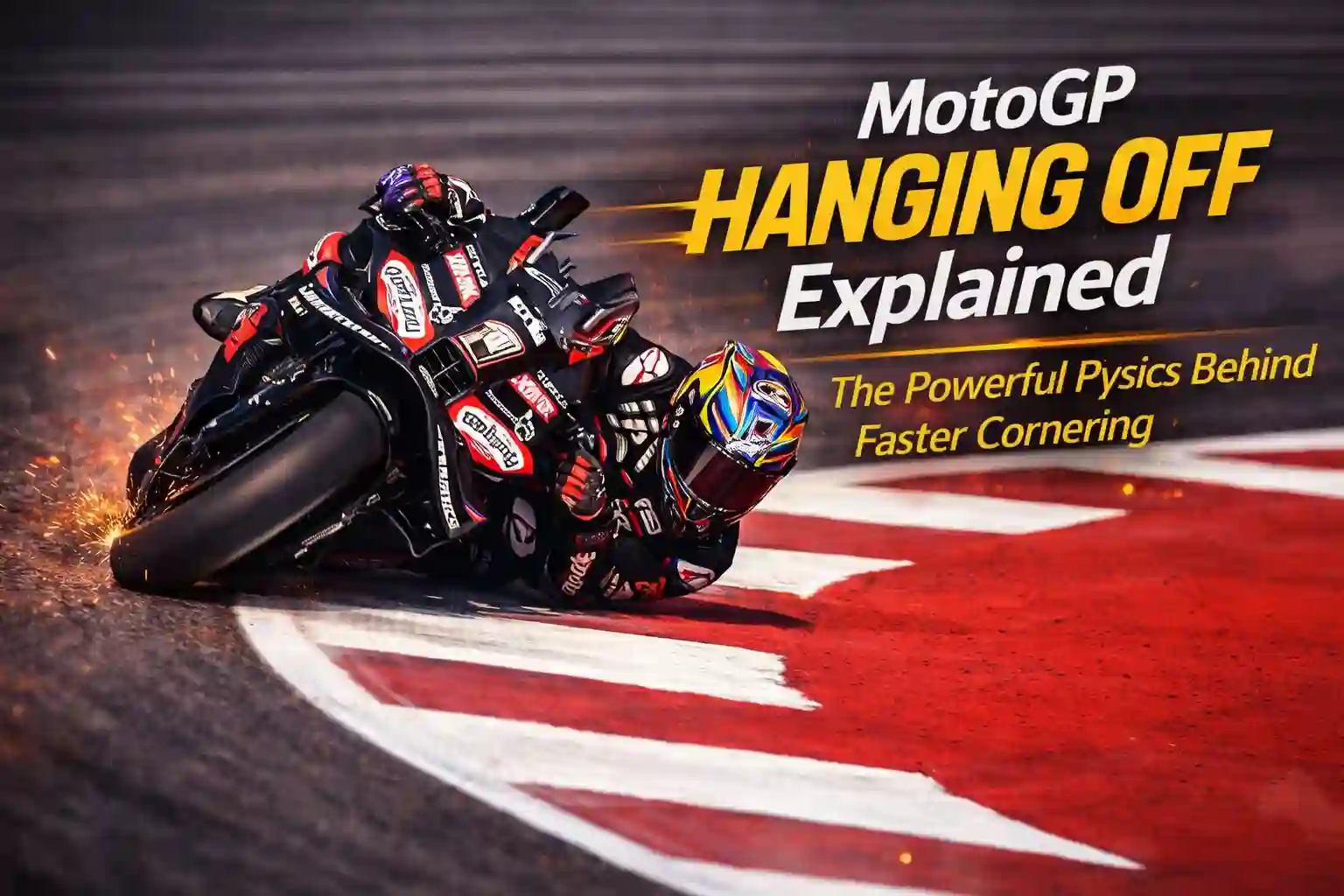
MotoGP hanging off explained starts with a simple but critical objective: maximize corner speed without exceeding tire grip limits. At elite level, riders are not just steering the bike—they are actively repositioning their body to manipulate physics in real time.
To understand why do MotoGP riders hang off the bike in corners, we need to analyze how body position influences center of mass, lean angle, tire contact patch, and ultimately lap time.
The Core Principle: Shifting the Center of Mass
Every motorcycle system has a combined center of mass (CoM) made up of:
- The bike
- The rider
When a rider hangs off:
- The CoM shifts toward the inside of the corner
- The bike itself requires less lean angle
- The tire maintains a stronger contact patch
Key Insight:
Reducing bike lean while maintaining corner speed = more available grip
The Physics of Cornering
A motorcycle in a corner balances two forces:
- Centrifugal force (pushing outward)
- Gravity (pulling downward)
The lean angle is what keeps these forces in equilibrium.
Without Hanging Off:
- Greater lean angle required
- Tire operates closer to its grip limit
With Hanging Off:
- Rider offsets body weight
- Bike remains more upright
- Greater margin for grip
Result:
- Higher corner speed
- Reduced crash risk
- Improved stability
Lean Angle vs Grip: Why It Matters
The tire contact patch is the only connection between the bike and the track.
As Lean Angle Increases:
- Contact patch shifts toward the tire edge
- Available grip decreases
- Risk of losing traction increases
Hanging Off Advantage:
- Keeps tire more upright
- Preserves a larger contact patch
- Improves grip consistency
Data Insight:
A reduction of just 2–3° in lean angle can:
- Increase corner speed by 1–2 km/h
- Deliver ~0.2–0.4 seconds per lap
Embed from Getty Images
The Most Important Phase: Corner Exit
While hanging off is most visible mid-corner, its biggest advantage comes on exit.
Why:
- Less lean = earlier throttle application
- More grip = better acceleration
Performance Gain:
- Early throttle = +0.1–0.2 seconds per straight
Key Insight:
Corner exit performance defines lap time—and body position directly influences it.
Body Position Breakdown: Step-by-Step
1. Braking Phase:
- Rider shifts weight slightly off the seat
- Prepares for corner entry
2. Corner Entry:
- Body moves inside
- Knee extends outward
3. Apex:
- Maximum body offset
- Knee and elbow close to track
4. Exit:
- Rider gradually returns upright
- Focus shifts to acceleration
The Role of Knee and Elbow Contact
Touching the track with a knee or elbow is not just visual—it’s functional.
Purpose:
- Provides feedback on lean angle
- Helps riders gauge grip limits
- Stabilizes body position
Key Insight:
Physical feedback improves precision at the limit.
Aerodynamics and Stability Effects
Hanging off also influences airflow and stability.
Effects:
- Lowers effective center of mass
- Slightly reduces aerodynamic drag
- Improves bike balance mid-corner
Even small changes in airflow can:
- Increase rider confidence
- Improve consistency
Embed from Getty Images
Case Study: Marc Márquez vs Francesco Bagnaia
Márquez:
- Extreme body positioning
- Saves front-end grip
- Enables aggressive corner entry
Bagnaia:
- Smooth, controlled hang-off
- Focus on exit speed
- Better tire preservation
Outcome:
Different styles—but both maximize the same physics principles.
Tire Temperature and Wear
Body position directly affects tire temperature.
Benefits:
- Even load distribution
- Reduced edge overheating
- Improved tire life
Data Insight:
Better body positioning can:
- Maintain consistent lap times
- Reduce degradation
Why Hanging Off Is Essential in MotoGP
Without Hanging Off:
- Higher lean angle required
- Reduced grip margin
- Slower corner speeds
With Hanging Off:
- Lower lean angle
- Greater grip
- Faster lap times
Key Conclusion:
Hanging off is not optional—it is fundamental to performance.
Embed from Getty Images
The Bigger Picture: Efficiency Over Aggression
MotoGP is not about pushing harder—it’s about using physics efficiently.
Riders who master body position:
- Use less tire load
- Maintain higher speeds
- Reduce risk
Key Insight:
Efficiency creates speed.
Final Insight
MotoGP hanging off explained ultimately comes down to one principle:
👉 Shift the body to reduce lean, increase grip, and maximize speed
By moving their body off the bike, riders:
- Optimize tire contact
- Improve corner speed
- Enhance acceleration
In a sport where milliseconds define success, body position is not just technique—it is a precise tool for controlling physics at the limit.
What does hanging off mean in MotoGP?
Hanging off refers to a riding technique where the rider shifts their body to the inside of the bike during cornering to improve balance, grip, and speed.
Why do MotoGP riders hang off the bike in corners?
Riders hang off to shift the center of mass, which allows the bike to remain more upright, increasing tire grip and enabling higher corner speeds.
How does hanging off improve cornering speed?
By reducing the bike’s lean angle, hanging off keeps more tire contact with the track, allowing riders to carry more speed through corners.
Does hanging off reduce the risk of crashing?
Yes. A more upright bike provides a larger grip margin, reducing the risk of losing traction and crashing.
What is the ideal lean angle in MotoGP?
MotoGP bikes can reach lean angles of 60–65 degrees, but hanging off helps reduce how much the bike itself needs to lean.
Why do riders stick their knee out in corners?
The knee acts as a reference point for lean angle and provides feedback about grip and track conditions.
Do all MotoGP riders use the same body position?
No. Riders have different styles, but all use some form of hanging off to maximize performance and grip.
