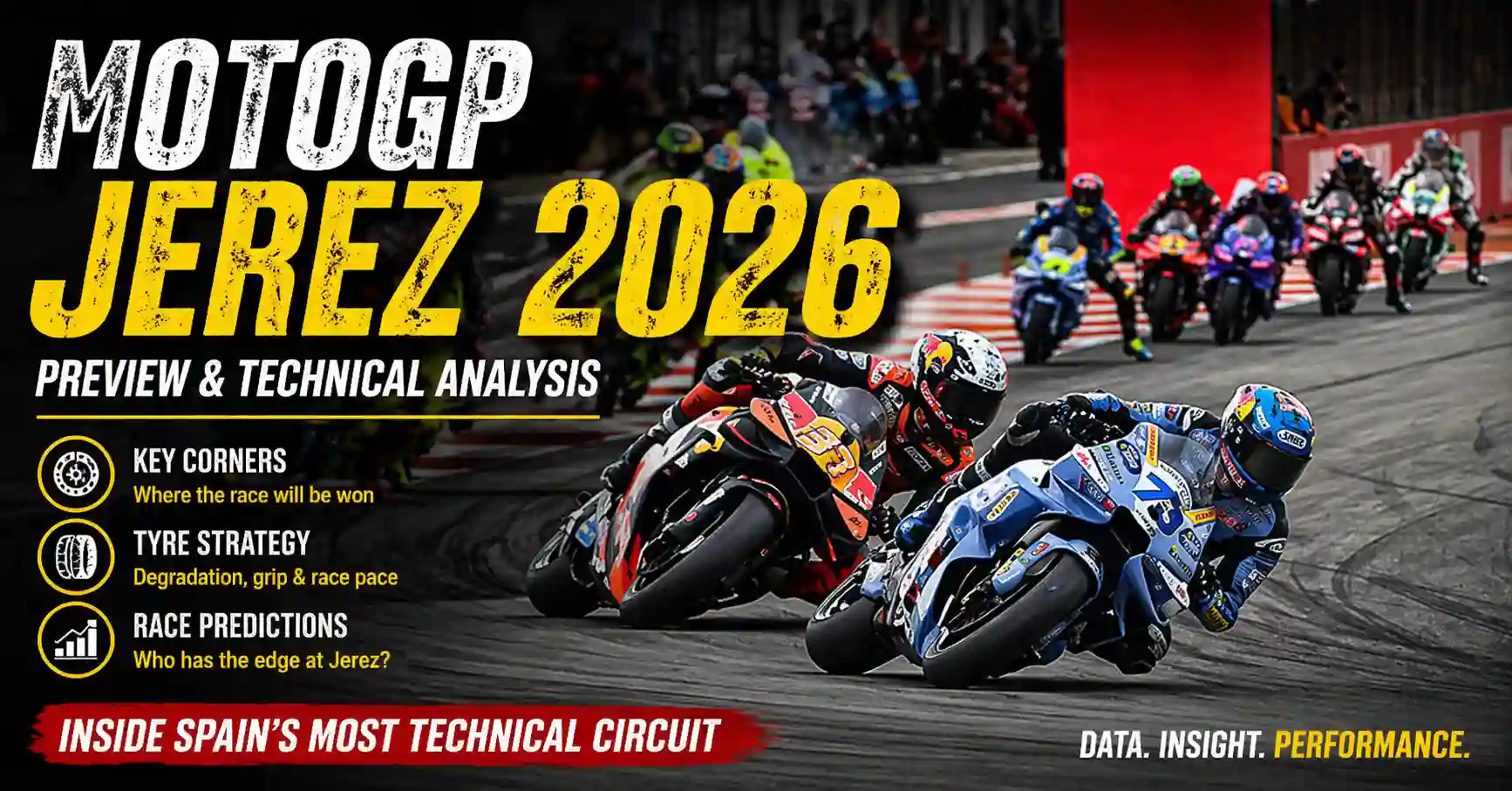
MotoGP Jerez 2026 preview begins with a clear performance reality: this is not a power circuit—it is a precision circuit. With lap times expected in the 1:36–1:38 range, the Spanish Grand Prix rewards riders who can maintain front-end grip, thermal tire stability, and consistent corner speed.
As part of this MotoGP Spanish GP 2026 race preview and analysis, the focus shifts away from straight-line performance and toward technical execution across every phase of the lap—especially braking and mid-corner balance.
Track DNA: Why Jerez Punishes Imperfection
The Circuito de Jerez – Ángel Nieto is defined by:
- Medium-speed, long-duration corners
- Frequent braking zones with short recovery phases
- Limited straights (reduced top-speed advantage)
- High dependence on front tire confidence
Key Technical Demands:
- Stable braking with controlled fork compression
- Smooth transition into lean angle
- Efficient throttle application on exit
Key Insight:
Jerez compresses multiple load phases into short distances, making setup precision more important than outright speed.
The Technical Core: Front-End Load and Grip
Front-end grip is the dominant factor at Jerez.
Why It Matters:
- Riders spend extended time at high lean angles
- Trail braking is used extensively
- The front tire must handle combined forces
Data Insight:
- Front load transfer peaks at ~80–90% under braking
- Lean angles regularly exceed 60°
Performance Impact:
- Strong front grip → higher entry speed
- Weak front grip → earlier braking and compromised lap time
Embed from Getty Images
The “Metrics” Section: Where Time Is Gained or Lost
Jerez rewards consistency over aggression.
| Performance Area | Key Metric | Impact on Lap Time |
|---|---|---|
| Braking zones | ~100–120 bar pressure | High |
| Mid-corner phase | Tire temp (90–110°C) | Very High |
| Corner exit | Slip ratio (~8–12%) | High |
Tire Degradation:
- Front tire overheating is the primary limitation
- Degradation can cost 0.2–0.4s per lap over a race stint
Strategy Insight:
- Riders who preserve front grip will gain time in later laps
- Aggressive early pace often leads to performance drop-off
Corner-by-Corner Breakdown: The Decisive Sections
Turn 1 – High-Energy Braking
- Entry: ~290 km/h → ~90 km/h
- Requires maximum stability and precise brake modulation
👉 Time gain potential: ~0.1 seconds
Turn 5 – Long-Duration Load
- Sustained lean angle
- Tests front tire temperature management
👉 Mistakes here affect the entire sector
Turn 6 – Dani Pedrosa Corner
- Tight entry requiring rotation
- Engine braking and rear control are critical
Turn 13 – Final Corner
- Long right-hander onto the main straight
- Exit speed directly impacts lap time
👉 Early throttle application is decisive
Embed from Getty Images
Technical Comparison: Who Has the Edge?
Ducati:
- Strong acceleration
- Slight disadvantage in tight rotation zones
KTM:
- Excellent braking stability
- Competitive entry performance
Yamaha:
- Superior corner speed
- Strong mid-corner balance
Key Insight:
Jerez reduces the advantage of raw power and emphasizes handling precision and tire management.
Electronics and Rider Input: Fine Margins Matter
At Jerez, performance depends heavily on:
- Engine braking control → stabilizes entry
- Traction control → manages rear slip on exit
- Throttle modulation → preserves tire life
Key Insight:
Electronics provide consistency, but smooth rider input defines peak performance.
Embed from Getty Images
Race Strategy: Why Consistency Wins
Unlike power circuits, Jerez rewards:
- Smooth riding style
- Controlled tire temperatures
- Stable lap times
Data Insight:
- Riders who overheat the front tire lose 0.3–0.5s per lap in later stages
Strategic Approach:
- Manage pace early
- Preserve front grip
- Push in final laps
The Critical Factor: Corner Entry Efficiency
Jerez is fundamentally an entry-dominated circuit.
- Late braking alone is not enough
- Stability and rotation define performance
Key Insight:
The fastest riders:
- Maintain front grip under braking
- Transition smoothly into lean
- Minimize instability
Prediction: What Will Decide the Race
Based on the circuit’s technical demands:
- Riders with strong front-end confidence will lead
- Smooth riding styles will outperform aggressive approaches
Expected Outcome:
- Close qualifying margins
- Race decided by tire management and consistency
Final Insight
MotoGP Jerez 2026 preview ultimately highlights one defining principle:
👉 Jerez rewards control, not aggression
- Front-end grip defines entry
- Stability defines consistency
- Precision defines lap time
In this MotoGP Spanish GP 2026 race preview and analysis, one factor stands above all: the ability to repeat high-performance laps without exceeding tire limits.
At Jerez, the fastest rider is not the one who pushes the hardest—it’s the one who manages the limit most effectively.
What makes the Jerez circuit unique in MotoGP?
Jerez is a technical circuit with medium-speed corners, heavy braking zones, and limited straights, making precision and front-end grip more important than top speed.
Why is front-end grip so important at Jerez?
Front-end grip is critical because riders spend long periods at high lean angles and rely heavily on braking stability during corner entry.
What is the average lap time at Jerez in MotoGP?
Typical lap times are in the 1:36–1:38 range, depending on conditions and race pace.
How does tire degradation affect the race at Jerez?
Front tire overheating is a major factor and can reduce performance by 0.2–0.4 seconds per lap over a race stint.
Which MotoGP bikes perform best at Jerez?
Bikes with strong cornering stability and front-end confidence, such as Yamaha and KTM, often perform well, while power advantage is less critical.
What role does braking play at Jerez?
Braking is crucial, especially in heavy zones like Turn 1, where stability and suspension control directly impact lap time.
