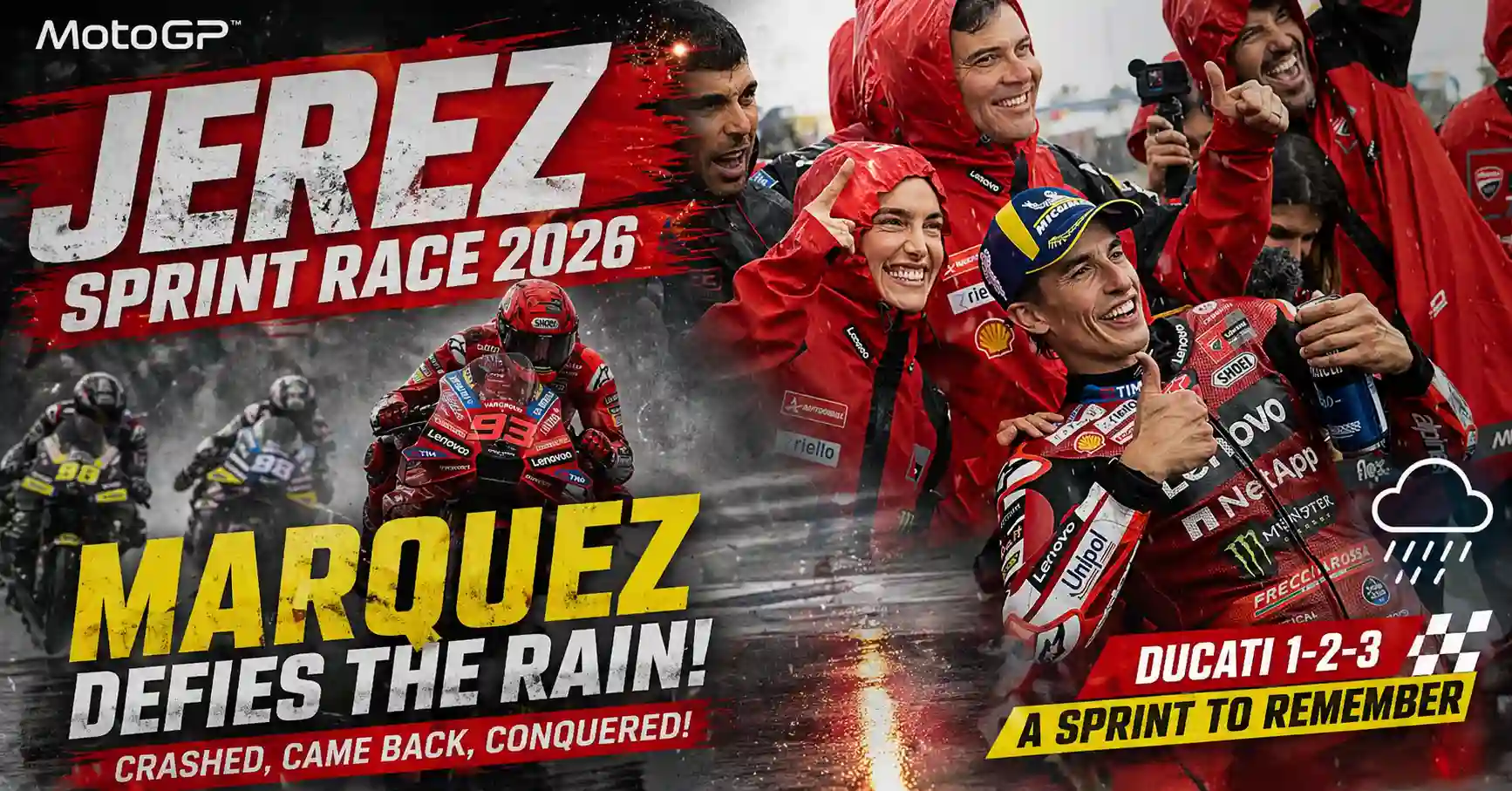
The MotoGP Jerez sprint race results 2026 were defined by one variable more than any other:
👉 Timing the switch from slicks to wet-weather bikes
What began as a dry 12-lap sprint quickly evolved into a mixed-condition race, creating one of the most chaotic data sets of the season.
Sprint Race Results: Top 10 Finishers:
| Position | Rider | Team | Gap |
|---|---|---|---|
| 1 | Marc Márquez | Ducati Lenovo Team | 21:25.651 |
| 2 | Francesco Bagnaia | Ducati Lenovo Team | +3.050 |
| 3 | Franco Morbidelli | VR46 Ducati | +7.493 |
| 4 | Brad Binder | KTM | +8.752 |
| 5 | Fabio Di Giannantonio | VR46 Ducati | +9.237 |
| 6 | Raúl Fernández | Trackhouse Aprilia | +11.958 |
| 7 | Fabio Quartararo | Yamaha | +13.525 |
| 8 | Johann Zarco | LCR Honda | +14.522 |
| 9 | Luca Marini | Honda HRC | +15.769 |
| 10 | Álex Rins | Yamaha | +15.821 |
The Critical Moment: Lap 7–8 Transition Window
Track Evolution:
- Laps 1–6 → Dry line, stable grip
- Lap 7 → Light rain, grip uncertainty
- Lap 8+ → Full wet conditions
Key Decision:
- Stay out on slicks ❌
- Pit for wet bike ✔️
Key Insight:
The race was effectively decided in a single lap decision window (~90 seconds).
Embed from Getty Images
Why Marc Márquez Still Won — Even After Crashing
This is where the race becomes technically fascinating.
The Crash That Helped Him Win
- Crash occurred at final corner (lap ~7)
- Crucially, bike was still operational
- Allowed immediate pit entry
👉 This resulted in:
- Perfect timing for bike swap
- Avoiding an extra lap on slicks in heavy rain
Technical Advantage Gained:
- Early switch to wet setup
- Immediate access to full wet grip
- No transitional lap time loss
Key Insight:
What looked like a mistake was actually a timing advantage in disguise.
The Strategy Split: Winners vs Losers
Correct Strategy Group:
- Marc Márquez
- Francesco Bagnaia
- Franco Morbidelli
- Brad Binder
👉 Pitted immediately when rain intensified
Incorrect Strategy Group:
- Stayed out one extra lap on slicks
- Lap times dropped by ~5–8 seconds
- Multiple crashes
👉 Example:
- Álex Márquez crashed after staying out
- Pedro Acosta also fell in low-grip phase
Embed from Getty Images
The Physics of the Chaos: Why Slicks Failed Instantly
On Slick Tires in Wet Conditions:
- No tread → no water displacement
- Contact patch collapses
- Grip coefficient drops dramatically
Result:
- Sudden loss of braking stability
- Rear wheel spin on entry
- Near-zero traction
Key Insight:
Grip didn’t reduce gradually—it collapsed instantly once rain intensity crossed a threshold.
Brad Binder’s Lost Victory: A Case of Over-Commitment
Binder briefly became the effective race leader after switching early.
Why He Was Leading:
- First riders on wets gained ~5–7s per lap
- Clean track + correct tire
What Happened:
- Crash with 2 laps remaining
- Lost control under wet braking
Technical Explanation:
- Overloaded front tire under reduced grip
- Wet conditions reduce margin for error
👉 Key Insight: Even with the correct strategy, execution under low grip is critical
Embed from Getty Images
The Ducati Advantage in Mixed Conditions
Despite chaos, Ducati locked out the podium.
Why Ducati Excelled:
- Strong braking stability
- Predictable engine braking
- Smooth power delivery
Result:
- Better control in low-grip transition
- Faster adaptation to wet conditions
Key Insight:
Ducati’s advantage is not just speed—it’s stability across changing grip conditions
The Biggest Loser: Marco Bezzecchi
- Championship leader crashed
- Failed to score
What Went Wrong:
- Poor track position early
- Could not capitalize on pit timing
- Crashed in chaotic mid-phase
👉 Key Insight:
Mixed conditions amplify mistakes—position and timing become critical
Data Summary: Sprint Race Under Mixed Conditions
| Factor | Dry Phase | Wet Phase |
|---|---|---|
| Lap time | ~1:37 | +5–10s slower |
| Grip level | High | Extremely low |
| Tire performance | Stable | Critical |
| Strategy importance | Low | Race-defining |
What This Means for the Main Race
The Sprint completely reshapes expectations.
If Dry:
- Ducati still strongest
- Tire degradation key
If Mixed/Wet:
- Strategy becomes dominant
- Rider adaptability decides outcome
Final Insight
MotoGP Jerez sprint race results 2026 will be remembered for one reason:
👉 It was not won by speed—it was won by decision-making under uncertainty
- Márquez combined skill + timing
- Ducati delivered stability
- Others lost out in a single lap
At Jerez, the limit is not just grip…
👉 It’s how fast you can adapt when grip disappears.
What happened in the MotoGP Jerez sprint race 2026?
1. What happened in the MotoGP Jerez sprint race 2026?
The MotoGP Jerez sprint race 2026 was heavily affected by rain, forcing riders to switch from slick tires to wet-weather bikes mid-race. Strategic timing and adaptability played a key role in determining the final results.
Who won the MotoGP Jerez sprint race 2026?
Marc Márquez won the sprint race despite crashing earlier, recovering quickly and making a perfectly timed switch to wet conditions.
How did weather impact the sprint race?
Rain drastically reduced grip levels, making slick tires ineffective. Riders who delayed switching to wet setups lost significant time or crashed.
Why was the bike switch so important?
MotoGP uses a flag-to-flag system in wet races. Riders must enter the pit lane and change bikes, and the timing of this decision directly impacts race outcome.
What is the difference between slick and wet tires in MotoGP?
Slick tires: Designed for dry conditions with maximum contact patch
Wet tires: Grooved to disperse water and maintain grip in rain
Did the sprint race predict the main race outcome?
Partially. The sprint revealed performance trends like braking stability and tire management, but full race conditions introduce additional factors like fuel load and long-run degradation.
