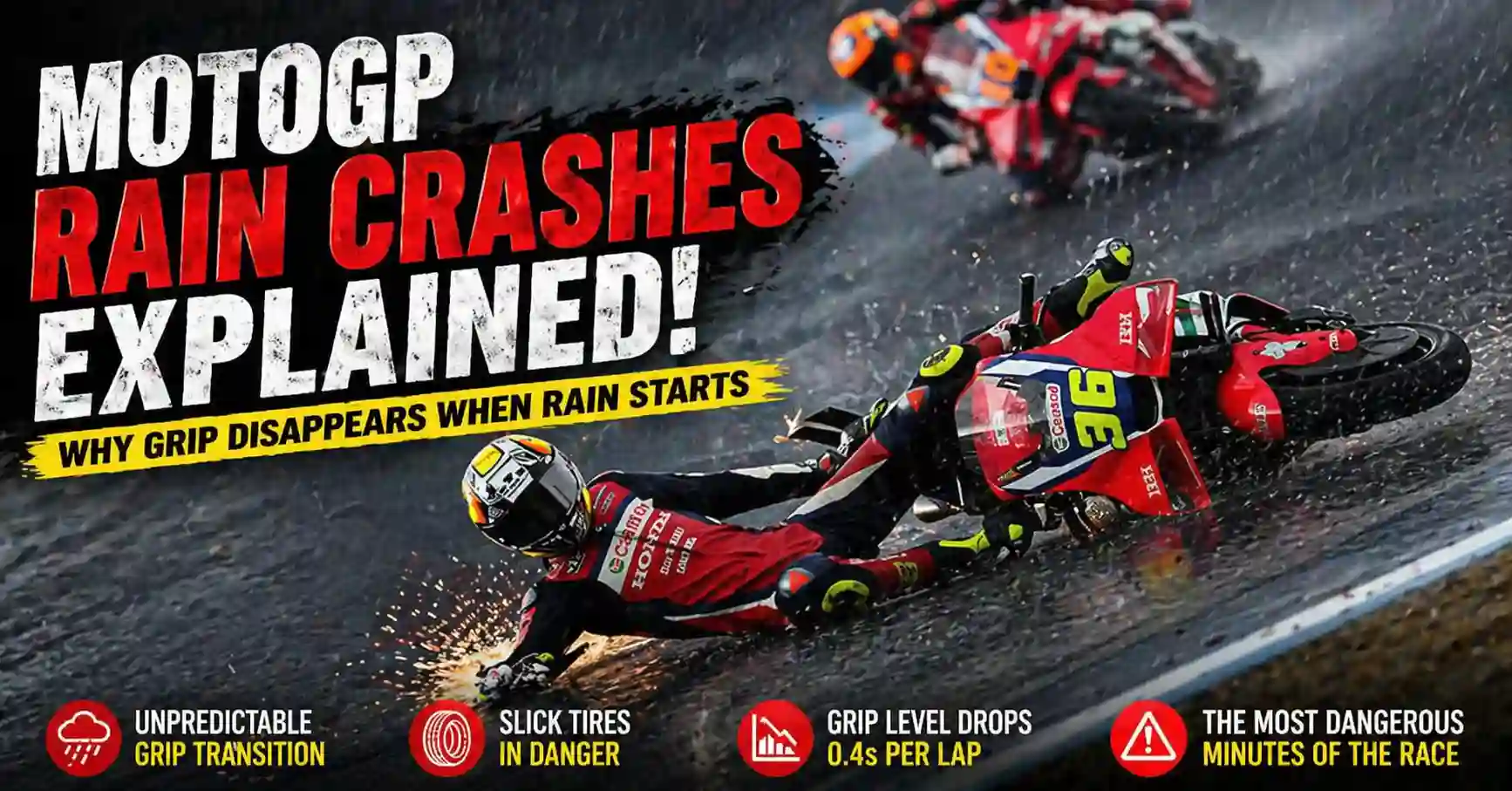
MotoGP rain crashes explained starts with a simple but critical fact: the most dangerous moment is not heavy rain—it’s the first few minutes of rainfall. This is when riders are still operating at near-dry pace while the track surface rapidly loses grip.
The result is a mismatch between available traction and rider input, and at MotoGP speeds, that mismatch is enough to trigger sudden, unrecoverable crashes.
This analysis breaks down why MotoGP riders crash more when rain starts, using physics, tire behavior, and real performance data.
The Transition Phase: Where Grip Becomes Unpredictable
At circuits such as Circuito de Jerez – Ángel Nieto, the initial rain phase creates a non-uniform grip surface.
Surface Characteristics:
- Dry racing line still holds heat
- Off-line areas cool rapidly
- Water begins forming a thin film
The Problem:
Grip varies corner-to-corner—and even within a single corner.
👉 Riders lose the ability to rely on consistent feedback from the front tire.
Embed from Getty Images
The Physics of Grip Loss
Grip in motorcycle racing is defined by the friction coefficient (µ) between tire and track.
Dry Conditions:
- µ ≈ 1.2–1.4
- Full tire contact with asphalt
Early Rain Conditions:
- µ drops to ~0.7–0.9
- Water film reduces contact
Additional Factor:
- Oil and rubber deposits mix with water
- Creates a highly slippery surface
Key Insight:
Grip reduction is not gradual—it drops sharply once a water layer forms between tire and asphalt.
Why Early Rain Is More Dangerous Than Full Wet
It seems counterintuitive, but crash data consistently shows:
👉 More incidents occur in light rain than in heavy rain.
Explanation:
- Riders are still on slick tires
- They continue pushing at high pace
- Grip has already dropped significantly
In Full Wet:
- Riders switch to wet tires
- Inputs become smoother
- Pace reduces
Key Insight:
The danger lies in the delay between grip loss and rider adaptation
The “Metrics” Section: Input vs Grip Threshold
| Condition | Grip Level (µ) | Rider Input | Risk Level |
|---|---|---|---|
| Dry | High (~1.3) | Maximum | Low |
| Damp (early rain) | Medium (~0.8) | High | Extreme |
| Full wet | Low (~0.6) | Reduced | Controlled |
Interpretation:
Crashes occur when rider demand exceeds available grip, especially during the transition phase.
Embed from Getty Images
Braking Zones: The Primary Failure Point
Under braking, up to 90% of load transfers to the front tire.
In Early Rain:
- Reduced grip cannot support load
- Front tire exceeds traction limit
- Instant washout
Key Insight:
Most rain-related crashes occur during initial braking phases
Corner Entry: Combined Forces Overload
Corner entry combines:
- Braking force
- Lateral (turning) force
In Damp Conditions:
- Available grip is reduced
- Combined forces exceed limit
Result:
- Rear instability
- Front loss of support
- Sudden crash
Tire Temperature Collapse
Rain rapidly reduces tire temperature.
Effects:
- Temperature drops below optimal (90–110°C)
- Rubber stiffens
- Mechanical grip decreases
Key Insight:
Grip loss is caused by both surface conditions and temperature reduction
Embed from Getty Images
The Rider Factor: Reaction Delay
MotoGP riders rely heavily on muscle memory.
Problem:
- Inputs are calibrated for dry grip
- Rain changes grip instantly
Adaptation Time:
- 1–2 laps required
Key Insight:
Crashes occur before riders fully adjust to new grip levels
Why Elite Riders Survive Better
Top riders like Marc Márquez manage this transition more effectively.
Key Skills:
- Progressive braking
- Controlled rear slip
- Smooth throttle application
Advantage:
- Operate closer to the limit without exceeding it
Strategic Factor: Tire Choice and Timing
Early rain introduces a key strategic decision:
Stay on Slicks:
- Faster on dry sections
- Dangerous on wet patches
Switch to Wet Tires:
- Safer overall
- Slower if track is not fully wet
Data Insight:
- Wrong tire choice can cost 5–10 seconds per lap
Embed from Getty Images
The Most Dangerous Track Areas
Certain sections amplify risk:
High-Risk Zones:
- Heavy braking areas
- Downhill corners
- Rubbered-in racing line
Why:
- Maximum load + reduced grip
The Core Principle: Controlled Instability
MotoGP riding is about managing instability.
In Dry:
- Instability is predictable
In Early Rain:
- Instability becomes chaotic
Key Insight:
The best riders don’t eliminate instability—they control it under changing conditions
Final Insight
MotoGP rain crashes explained ultimately comes down to one fundamental mismatch:
👉 Rider input remains high while grip drops instantly
- Friction decreases rapidly
- Tire temperature falls
- Surface becomes inconsistent
For a brief but critical window, riders are still riding at dry limits—on a wet track.
That is where crashes happen.
Why is light rain more dangerous than heavy rain in MotoGP?
Why do MotoGP riders crash more when rain starts?
MotoGP riders crash more when rain begins because grip drops suddenly while riders are still pushing at dry-race intensity. This mismatch between tire grip and rider input leads to instability.
What causes grip loss in MotoGP rain conditions?
Grip loss is caused by a thin water layer forming between the tire and track, reducing friction. Oil and rubber deposits on the surface make this effect even worse.
Are slick tires dangerous in the rain?
Yes, slick tires are extremely dangerous in wet conditions because they have no grooves to disperse water, leading to a rapid loss of traction.
Why is light rain more dangerous than heavy rain in MotoGP?
Light rain creates inconsistent grip across the track, while riders are still using slick tires. In heavy rain, riders switch to wet tires and adjust their riding style, reducing risk.
How does rain affect MotoGP braking?
Rain significantly reduces front tire grip, making braking unstable. Since most braking force is applied to the front tire, this often leads to sudden crashes.
What is aquaplaning in MotoGP?
Aquaplaning occurs when water builds up between the tire and track, preventing direct contact and causing a complete loss of grip.
