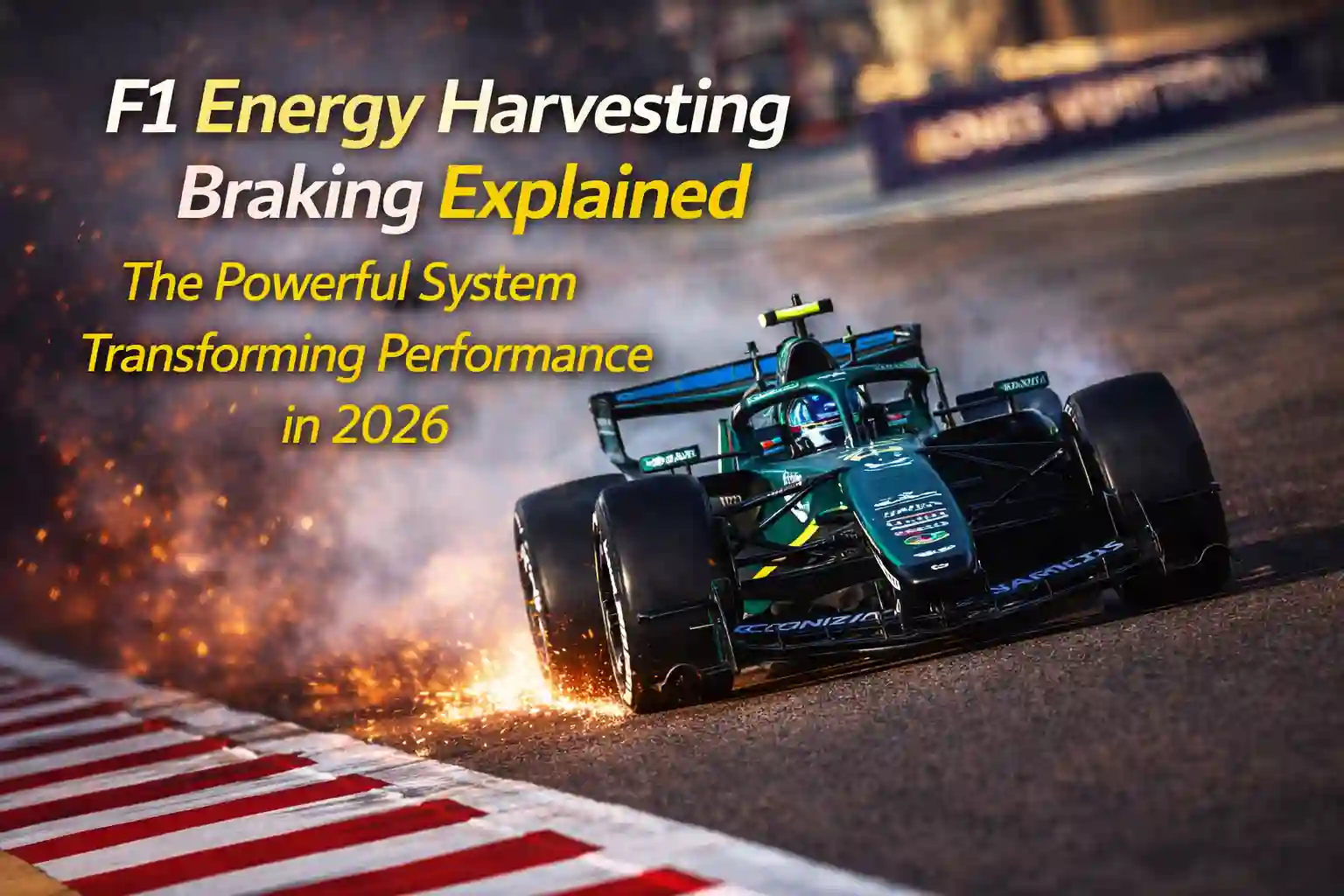
F1 energy harvesting braking has become one of the most decisive performance factors in the 2026 era, where hybrid systems contribute nearly 50% of total power output. Under heavy deceleration—often exceeding 5G—Formula 1 cars are not just slowing down; they are actively converting kinetic energy into electrical energy for later deployment.
This dual-purpose braking system creates a complex interaction between mechanical braking, electrical harvesting, and brake bias, making it a critical component of lap time optimization. To fully understand this, we must also explore how brake bias works in F1 2026 and how it adapts to energy recovery demands.
The Dual Nature of Braking in Modern F1
Braking in 2026 Formula 1 is no longer purely mechanical. It is a hybrid process combining:
1. Mechanical Braking
- Carbon brake discs generate friction
- Controlled directly by pedal pressure
- Provides the majority of stopping force
2. Electrical Braking (ERS via MGU-K)
- Converts kinetic energy into electrical energy
- Applies resistance at the rear axle
- Stores energy in the battery (~4MJ per lap)
Key Insight:
Electrical harvesting effectively acts as rear braking force, meaning braking balance must account for both systems simultaneously.
What Is Brake Bias and Why It Matters
Brake bias defines how braking force is distributed across the car:
- Front bias (55–60%) → Stability under braking
- Rear bias (50–54%) → Improved rotation, higher risk
Core Function:
- Maintains stability during deceleration
- Prevents wheel lock-up
- Optimizes corner entry
2026 Complexity:
Because ERS adds braking force at the rear, traditional brake bias setups must be dynamically adjusted to compensate.
Embed from Getty Images
How Energy Harvesting Works in Braking Zones
Energy harvesting occurs primarily during high-speed braking.
Process:
- Driver applies brake pedal
- MGU-K engages and resists rear wheel rotation
- Kinetic energy is converted into electrical energy
- Energy is stored for later use
Performance Data:
- Energy recovery: up to ~2MJ per heavy braking event
- Total per lap: ~4MJ
- Maximum electrical output: ~350 kW
The Critical Interaction: Brake Bias vs ERS
This is where performance is defined.
High Harvesting Scenario:
- Increased rear braking force
- Requires more front brake bias
- Prevents rear instability
Low Harvesting Scenario:
- Reduced rear braking contribution
- Allows rearward brake bias
- Improves rotation into corners
Key Principle:
Brake bias must dynamically adapt to energy harvesting intensity.
The Metrics: Balancing Stability and Performance
| Variable | Effect on Performance |
|---|---|
| Front Bias Increase | Stability ↑, rotation ↓ |
| Rear Bias Increase | Rotation ↑, instability ↑ |
| ERS Harvesting Increase | Rear load ↑, lock-up risk ↑ |
| Balanced System | Optimal braking + energy recovery |
Sector-by-Sector Impact
Heavy Braking Zones (End of Straights)
- Maximum harvesting
- Brake bias shifts forward
- Stability prioritized
Medium-Speed Corners
- Moderate harvesting
- Balanced bias
- Focus on rotation
Slow Corners
- Reduced harvesting
- Rear bias increased
- Improved agility
Embed from Getty Images
Case Study: Red Bull Racing vs Mercedes
Observations:
Red Bull Racing:
- Smooth, progressive energy harvesting
- More rearward brake bias
- Superior corner entry rotation
Mercedes:
- Aggressive harvesting strategy
- Higher front bias requirement
- Slightly reduced entry agility
Result:
- Red Bull gains ~0.1–0.2 seconds per lap in corner entry phases
Driver Control: Real-Time Brake Bias Adjustments
Drivers actively adjust brake bias using steering wheel controls.
Why Adjust?
- Changing tire grip levels
- Fuel load variation
- ERS deployment and harvesting changes
Typical Adjustments:
- Early race → more rear bias (heavier car)
- Late race → more front bias (lighter car, instability risk)
Tire Temperature and Thermal Management
Braking and energy harvesting directly influence tire behavior.
Front Tires:
- Excessive load → overheating
- Leads to understeer
Rear Tires:
- Excess harvesting → instability or lock-up
- Leads to snap oversteer
Key Insight:
Thermal balance is essential for maintaining consistent lap time.
Why This System Defines Performance in 2026
Three key reasons:
1. Increased Electrical Contribution
ERS now delivers a major portion of total power.
2. Integrated Energy Strategy
Braking is directly linked to acceleration performance.
3. Precision-Based Gains
Small inefficiencies in braking balance cost tenths per lap.
Embed from Getty Images
The Bigger Picture: Braking as Energy Conversion
Modern F1 braking is no longer just about slowing the car.
It is:
- Energy generation
- Stability management
- Performance optimization
Every braking zone becomes a trade-off between:
- Maximizing energy recovery
- Maintaining control
- Preparing for corner entry
Final Insight
F1 energy harvesting braking represents a fundamental shift in how performance is achieved in Formula 1.
Brake bias and ERS are now fully interconnected systems:
- Too much rear energy → instability
- Too much front bias → reduced rotation
- Perfect balance → maximum lap time
The teams that master this balance gain a measurable advantage across every lap.
In 2026, braking is not just about reducing speed—it is about transforming it into future performance.
What is F1 energy harvesting braking?
F1 energy harvesting braking is a system where kinetic energy generated during braking is converted into electrical energy using the MGU-K and stored for later use.
How does energy harvesting work in Formula 1?
During braking, the MGU-K captures energy from the rear axle and converts it into electrical energy, which is stored in the battery and later used to boost performance.
How much energy can an F1 car recover under braking?
An F1 car can recover up to ~2MJ of energy per heavy braking zone, with a total of around 4MJ per lap depending on the circuit.
What is the role of brake bias in F1?
Brake bias controls how braking force is distributed between the front and rear wheels, helping maintain stability and optimize corner entry.
How does brake bias interact with energy harvesting?
Since energy harvesting adds braking force to the rear wheels, drivers must adjust brake bias to prevent instability or rear lock-up.
Why is energy harvesting important in F1 2026?
Energy harvesting is crucial because the electrical system contributes a significant portion of total power, making energy management key to performance.
