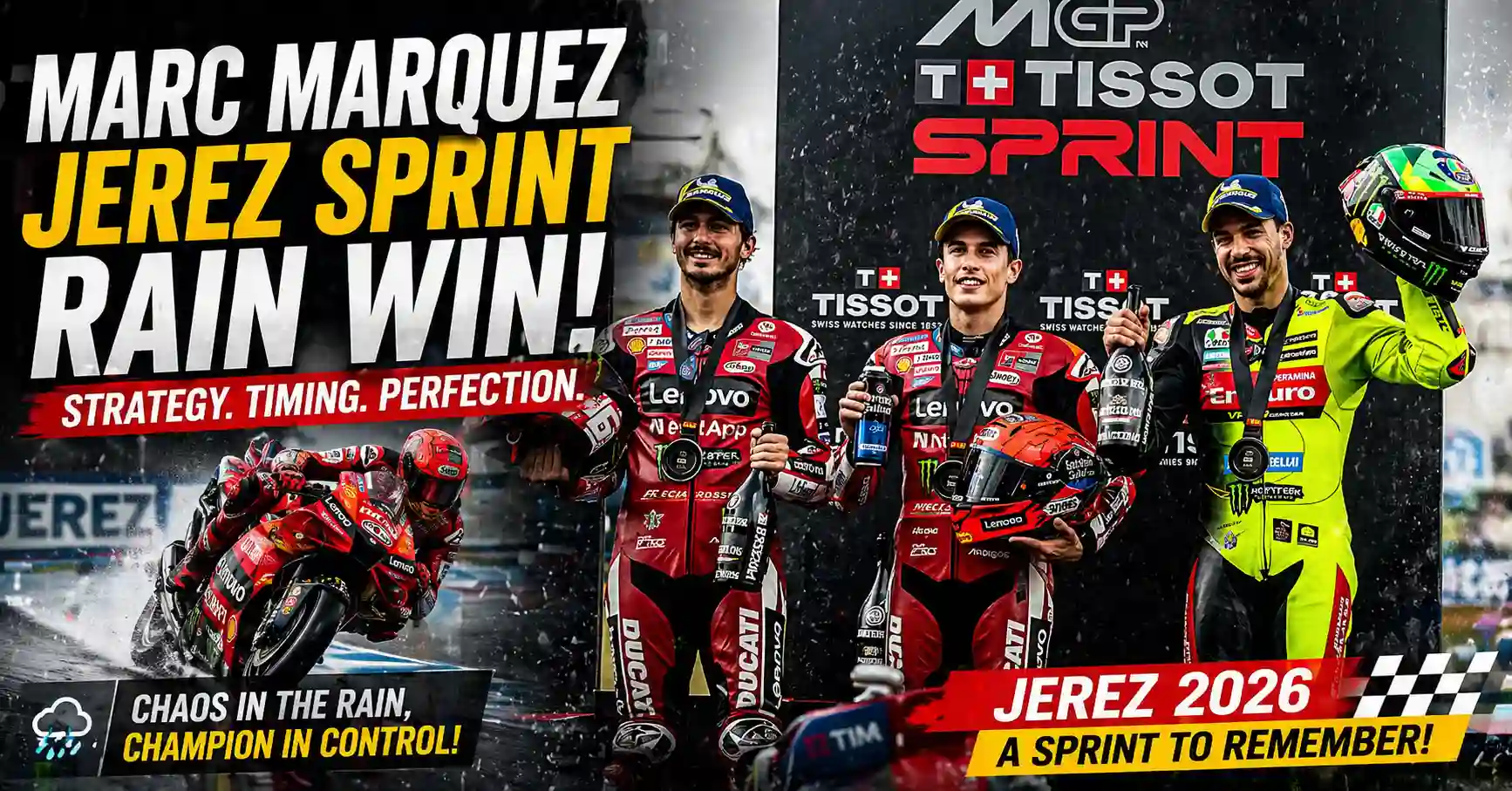
Marc Marquez Jerez sprint rain win was not defined by outright speed—it was defined by decision timing, tire physics, and precision under unstable conditions. What looked like a chaotic race was, in reality, a perfect case study in MotoGP strategy execution under mixed weather conditions.
This analysis explains why Marc Marquez won Jerez sprint in rain by breaking down the exact technical factors that turned a crash into a decisive advantage.
The Turning Point: A 90-Second Strategic Window
At Circuito de Jerez – Ángel Nieto, the race pivoted between lap 7 and lap 8.
Track Evolution Timeline:
- Laps 1–6: Dry racing line, stable grip
- Lap 7: Light rain, unpredictable traction
- Lap 8+: Heavy rain, full wet conditions
Strategic Choice:
- Stay out on slicks → immediate loss of control
- Pit for wet bike → regain stability
Key Insight:
The race outcome was determined within a single lap decision window (~90 seconds).
Embed from Getty Images
The Crash That Changed Everything
What appeared to be a mistake by Marc Márquez became the defining moment of the race.
What Happened:
- Crash at final corner just before pit entry
- Bike remained operational
- Immediate access to pit lane
Strategic Advantage:
- Perfect timing for bike swap
- Avoided one additional lap on slick tires in heavy rain
Quantified Impact:
- Riders who delayed lost ~5–8 seconds per lap
- Márquez effectively skipped the worst transition phase
👉 Key Insight: In mixed conditions, timing outweighs track position
The Physics of Grip Collapse
Slick Tires in Rain:
- No grooves → no water evacuation
- Water layer forms between tire and track
- Grip coefficient drops dramatically
Result:
- Loss of braking stability
- Uncontrolled rear slip
- Near-zero traction
Key Insight:
Grip does not degrade gradually—it collapses instantly once water exceeds a threshold.
Embed from Getty Images
Bike Swap Strategy: The Decisive Factor
MotoGP’s flag-to-flag system allows riders to switch bikes mid-race.
Key Variables:
- Pit lane time loss: ~20–25 seconds
- Slick lap loss in heavy rain: ~6–10 seconds
Break-Even Point:
- Staying out becomes slower after one lap in heavy rain
Why Márquez Won:
- Pitted at the exact crossover moment
- Maximized wet tire performance immediately
👉 Key Insight: Strategy is not about reacting—it’s about anticipating grip loss before it happens
The “Metrics” Section: Data Behind the Win
| Parameter | Dry Phase | Transition Phase | Wet Phase |
|---|---|---|---|
| Lap Time | ~1:37 | +5–10s | Stabilized |
| Grip Level | High | Extremely Low | Moderate |
| Slip Ratio | ~8–12% | Uncontrolled | Controlled |
| Brake Pressure | ~110–120 bar | Reduced | Progressive |
Interpretation:
- Transition phase is the most critical
- Correct tire restores predictability, not just speed
Why Márquez Was Faster in the Wet
1. Braking Control
- Smooth pressure application
- Avoided front tire overload
2. Rear Slip Management
- Controlled rotation instead of resisting slide
- Maintained stable entry
3. Throttle Modulation
- Progressive acceleration
- Prevented excessive wheelspin
Key Insight:
Wet performance depends on control of instability, not elimination of it
Embed from Getty Images
Ducati’s Advantage in Mixed Conditions
Ducati’s dominance in the sprint was not coincidental.
Strength Areas:
- Stable braking platform
- Predictable engine braking
- Smooth power delivery
Result:
- Better adaptability to changing grip levels
- Reduced risk during transition phase
Key Insight:
The bike amplified rider inputs, allowing greater precision under low grip
The Strategy Divide: One Lap That Defined the Race
Correct Strategy:
- Early switch to wet bike
- Maintained consistent lap times
Incorrect Strategy:
- Stayed out on slicks
- Lost 5–8 seconds instantly
- Increased crash risk
Examples:
- Multiple riders crashed during transition
- Others lost positions due to delayed decisions
👉 Key Insight: The penalty for hesitation was immediate and irreversible
Why Others Couldn’t Match the Pace
Even riders with similar speed could not replicate the result.
Key Limitations:
- Delayed pit timing
- Poor adaptation to grip change
- Inconsistent braking under wet conditions
Data Insight:
- Small errors in wet conditions lead to exponential time loss
Embed from Getty Images
The Bigger Picture: Strategy vs Speed
The sprint race highlighted a fundamental principle:
- Speed wins dry races
- Strategy wins mixed-condition races
Key Comparison:
| Factor | Dry Race | Wet/Mixed Race |
|---|---|---|
| Winning Factor | Lap time | Decision timing |
| Tire Importance | High | Critical |
| Rider Input | Aggressive | Controlled |
Final Insight
Marc Marquez Jerez sprint rain win ultimately came down to one defining principle:
👉 The ability to adapt faster than the conditions change
- Perfect timing of bike swap
- Superior control under low grip
- Minimal performance loss during transition
This was not just a race victory—it was a demonstration of strategic intelligence combined with technical precision.
At Jerez, when grip disappeared, Márquez didn’t just react…
👉 He adapted faster than everyone else.
How did Marc Márquez win the Jerez sprint race in the rain?
Marc Márquez won by making a perfectly timed switch to a wet-weather bike just as track conditions deteriorated, combined with superior control under low-grip conditions.
Why was timing so important in the Jerez sprint race?
The race conditions changed rapidly due to rain. Riders who switched bikes at the right moment avoided losing 5–10 seconds per lap, making timing the most critical factor.
What is a flag-to-flag race in MotoGP?
A flag-to-flag race allows riders to enter the pit lane and switch bikes when weather conditions change, enabling them to adapt from dry to wet setups during the race.
Why do MotoGP riders switch bikes instead of tires?
MotoGP bikes are pre-configured for different conditions. Switching bikes is faster and safer than changing tires mid-race, especially during unpredictable weather.
What is the difference between slick and wet tires
Slick tires: Designed for dry conditions with maximum surface contact
Wet tires: Grooved to disperse water and maintain grip in rain
How does rain affect MotoGP bike performance?
Rain reduces grip dramatically, making braking, cornering, and acceleration more difficult. Riders must use smoother inputs to maintain control.
