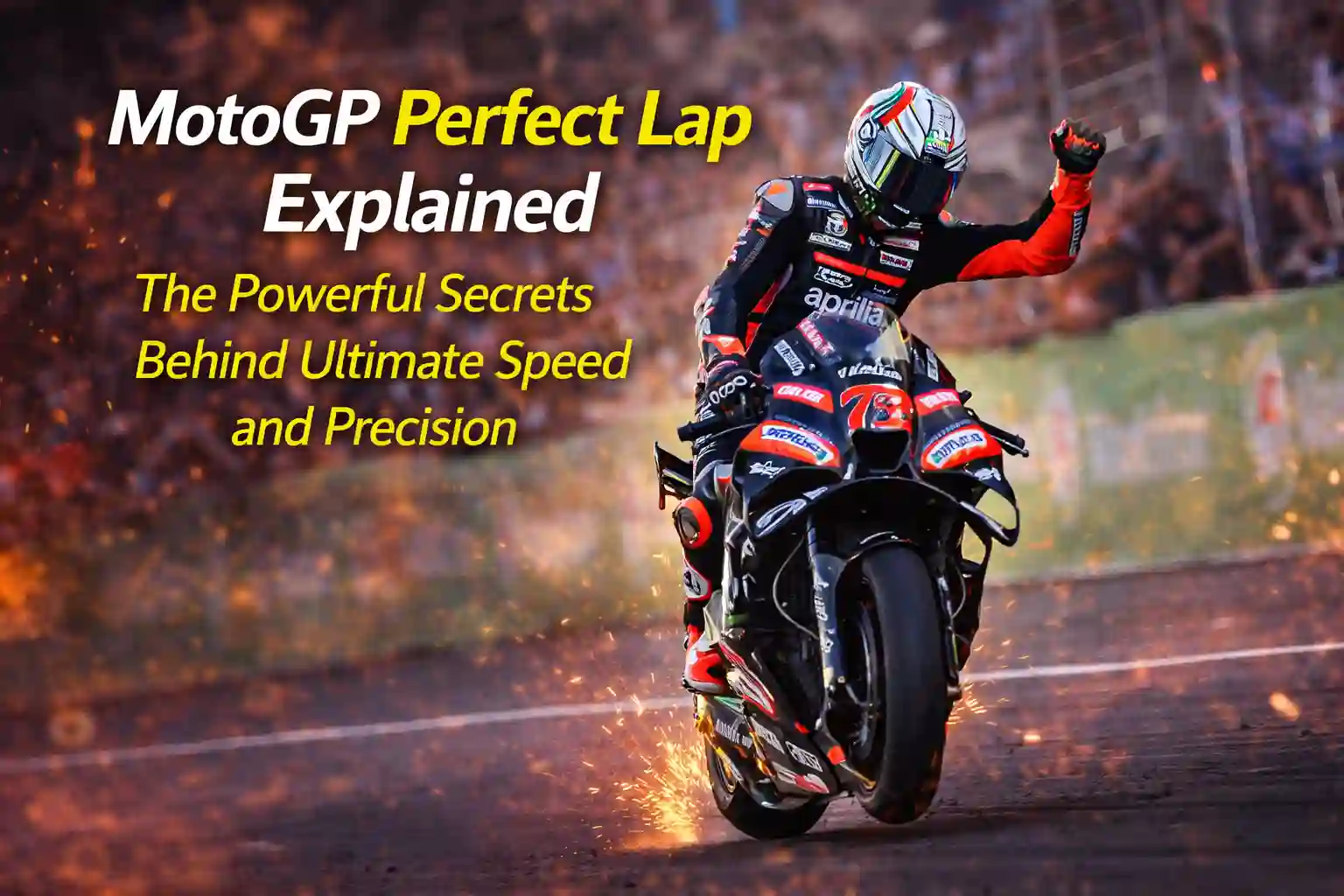
MotoGP perfect lap execution is not about a single heroic moment—it is a precise combination of braking, cornering, and acceleration repeated with near-zero error. At the highest level, the difference between pole position and the second row is often less than 0.3 seconds, meaning every phase of a lap must be optimized.
To understand what makes a perfect lap in MotoGP, we need to break the lap into its core sectors and analyze the physics, rider inputs, and performance metrics that define elite-level riding.
The Structure of a Perfect Lap
Every MotoGP lap can be divided into four key performance zones:
- Braking phase
- Corner entry and apex
- Corner exit
- Straight-line acceleration
Each phase contributes differently to lap time, but more importantly, each phase influences the next. A mistake early in the sequence carries through the entire lap.
Sector 1: Braking — Precision Under Maximum Load
Braking is the first opportunity to gain time—and one of the most difficult to perfect.
Key Performance Factors:
- Maximum deceleration without locking the front
- Smooth brake pressure modulation
- Stable load transfer to the front tire
Technical Metrics:
- Deceleration: 1.5–1.7G
- Brake pressure: up to 130 bar
- Speed reduction: often 150 km/h+
Performance Insight:
Elite riders brake just 2–4 meters later than competitors. That small margin alone can deliver ~0.05–0.1 seconds per corner.
Physics:
- Weight transfer increases front grip
- Excess load → front tire collapse (lowside risk)
Embed from Getty Images
Sector 2: Corner Entry and Apex — Balance and Control
This phase defines how well a rider carries speed through the corner.
What Happens:
- Maximum lean angle (~60–65°)
- Minimal throttle input
- Fine steering corrections
Key Variables:
- Entry speed
- Line precision
- Chassis stability
Data Insight:
A gain of just 1 km/h in minimum corner speed can result in:
- 0.02–0.05 seconds improvement per corner
Key Principle:
Smoothness is faster than aggression. Sudden inputs destabilize the bike and reduce grip.
Sector 3: Corner Exit — Where Lap Time Is Truly Created
Corner exit is the most critical phase of a MotoGP lap.
Why It Matters:
- Determines straight-line speed
- Influences the next braking zone
- Compounds gains across sectors
Key Factors:
- Throttle timing
- Rear tire grip
- Traction control behavior
Technical Insight:
- Optimal rear slip: ~5–10%
- Early throttle = 0.1–0.2 seconds gained per straight
Risk:
- Too aggressive → wheelspin and overheating
- Too conservative → lost acceleration
Key Takeaway:
The best riders maximize acceleration without exceeding grip limits.
Embed from Getty Images
Sector 4: Straight-Line Performance — Maximizing Momentum
While less technical than corners, straights are still performance-critical.
Key Variables:
- Aerodynamic tuck position
- Slipstream (drafting)
- Gear ratios and engine mapping
Data Insight:
- Speed advantage: +5–10 km/h
- Lap time gain: ~0.1–0.15 seconds per straight
Important Note:
Straight-line speed is largely determined by how well the previous corner exit was executed.
The Metrics: Where Time Is Gained
| Sector | Key Focus | Time Gain Potential |
|---|---|---|
| Braking | Late braking | +0.05–0.1s |
| Corner Entry/Apex | Minimum speed | +0.02–0.05s |
| Corner Exit | Early throttle | +0.1–0.2s |
| Straights | Top speed | +0.1–0.15s |
Key Insight:
Corner exit contributes the largest portion of total lap time gain.
Case Study: Francesco Bagnaia vs Jorge Martín
Observed Differences:
Bagnaia:
- Smooth throttle application
- Strong exit speed
- Consistent lap times
Martín:
- Aggressive braking
- Higher entry speed
- Slightly more tire stress
Outcome:
- Bagnaia gains time on exits
- Martín gains time on entry
The fastest lap often depends on which style best suits the track.
The Role of Tires in a Perfect Lap
Tires are the foundation of performance.
Optimal Temperature Range:
- 100–120°C
Effects of Temperature:
- Below range → reduced grip
- Above range → overheating and instability
Data Insight:
A +5°C increase can:
- Reduce grip consistency
- Increase lap time by ~0.1 seconds
Embed from Getty Images
Electronics vs Rider Input
Modern MotoGP bikes use:
- Traction control
- Engine braking maps
- Anti-wheelie systems
However:
The rider still controls:
- Throttle modulation
- Brake pressure
- Line selection
Key Insight:
Electronics assist performance—but precision rider input defines the perfect lap.
How Small Gains Build a Perfect Lap
A perfect lap is the sum of small advantages.
Example:
- 10 corners × 0.05s gain = 0.5 seconds per lap
This margin can decide:
- Pole position
- Race outcomes
The Bigger Picture: Flow State and Efficiency
The fastest laps are characterized by:
- Smooth transitions
- Minimal corrections
- Consistent inputs
Key Concept:
A perfect lap feels effortless because every input is aligned with the bike’s physics.
Final Insight
MotoGP perfect lap execution is about precision, not aggression.
- Braking defines entry potential
- Apex defines balance
- Exit defines lap time
- Straights reward momentum
The riders who master this sequence are not just faster—they are more efficient, more consistent, and more in control of every millisecond.
That is what truly defines perfection in MotoGP.
What is a MotoGP perfect lap?
A MotoGP perfect lap is a lap where a rider maximizes performance in every sector—braking, cornering, and acceleration—without any mistakes or loss of momentum.
Which part of the lap is most important in MotoGP?
Corner exit is the most important phase because it determines speed on the following straight and directly impacts overall lap time.
How much lap time can be gained per corner?
Small gains of 0.02 to 0.1 seconds per corner can add up to significant lap time improvements over a full lap.
How do tires affect a MotoGP perfect lap?
Tires provide grip and stability. If they are outside the optimal temperature range, grip decreases and lap time increases.
What role does telemetry play in MotoGP lap performance?
Telemetry helps teams analyze throttle, braking, and speed data to identify where riders can improve lap time.
Do electronics control the bike during a perfect lap?
Electronics assist with traction and stability, but the rider’s inputs—throttle, braking, and line—are still the most important factors.
