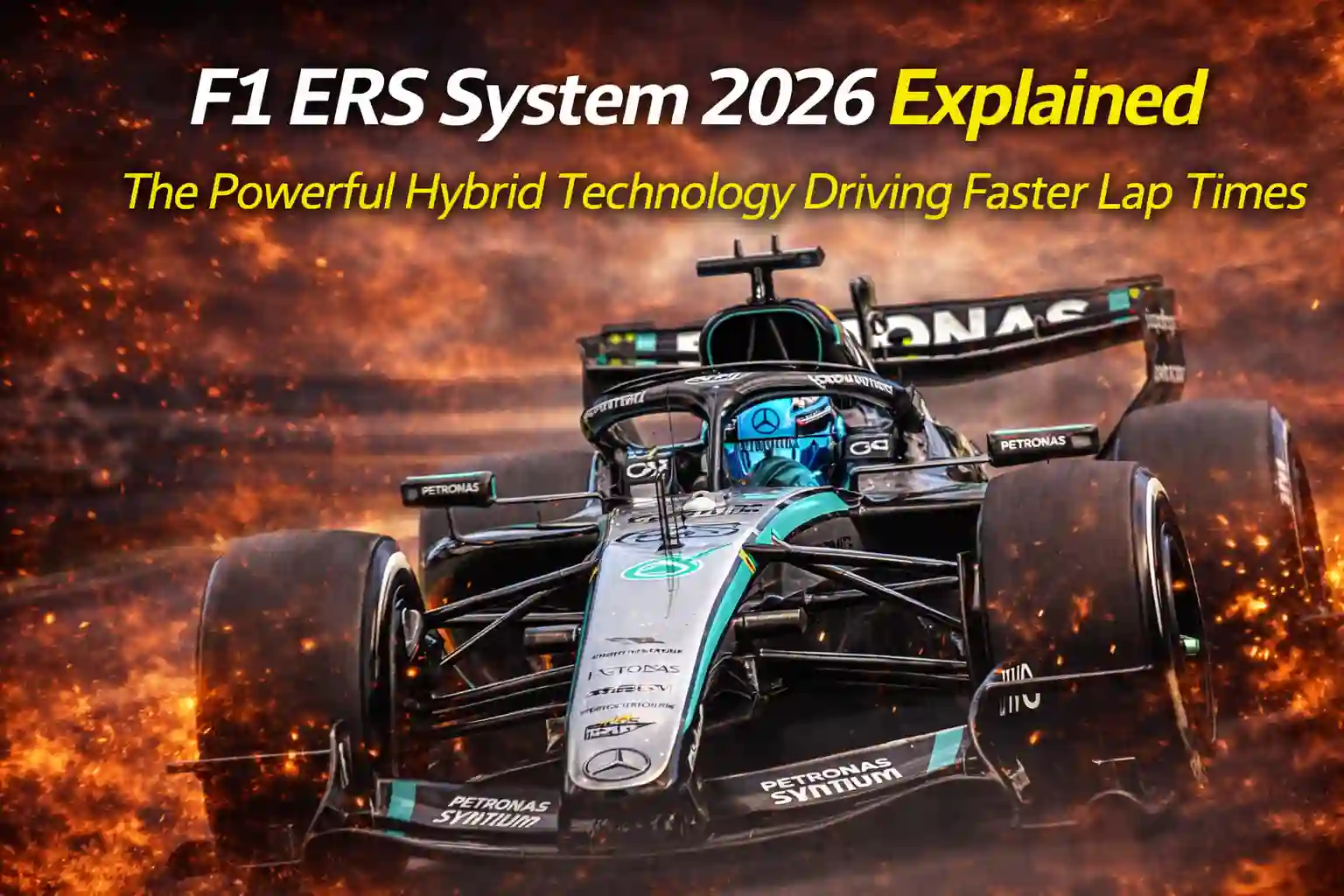
F1 ERS system 2026 is no longer a supplementary performance tool—it is now responsible for nearly 50% of total power delivery. With electrical output reaching ~350 kW, the hybrid system has evolved into the defining factor of lap time, overtaking capability, and race strategy.
In this technical deep dive, we break down how the system works, how energy is harvested and deployed, and why mastering it is now the key differentiator across the grid. This also serves as a complete F1 MGU-K deployment explained guide, with a sector-by-sector analysis of real performance impact.
The Architecture of the 2026 ERS System
The modern Formula 1 power unit consists of two core elements:
- Internal Combustion Engine (ICE)
- Electrical system (ERS via MGU-K)
Key Components:
- MGU-K (Motor Generator Unit – Kinetic) → Converts braking energy into electrical energy
- Energy Store (battery) → Stores ~4MJ per lap
- Control Electronics → Manage deployment strategy
Key Numbers:
- Maximum electrical output: ~350 kW (~470 hp)
- Energy deployment per lap: ~4MJ
- Energy recovery efficiency: up to 80% in optimal braking zones
This shift toward electrification means energy is no longer just recovered—it is strategically redistributed across the lap.
How Energy Is Harvested
Energy harvesting occurs primarily during braking phases.
Process:
- Driver applies brakes
- Kinetic energy from the wheels is captured
- MGU-K converts it into electrical energy
- Energy is stored in the battery
Performance Insight:
- Heavy braking zones can recover ~2MJ per event
- Multiple braking zones per lap create a full energy cycle
Trade-Off:
- Excessive harvesting → destabilizes braking
- Insufficient harvesting → limits deployment later
This balance is central to race performance.
Embed from Getty Images
How Energy Is Deployed
Deployment occurs when the driver accelerates, particularly:
- Corner exits
- Straights
- Overtaking zones
Key Benefits:
- Increased acceleration
- Higher top speed
- Improved overtaking potential
Data Insight:
- Lap time gain: ~0.5–0.8 seconds per lap
- Speed gain: +8–12 km/h on long straights
Sector-by-Sector Breakdown of Performance
Sector 1: Corner Exit Acceleration
- ERS deployment begins immediately after apex
- Boost improves traction-limited acceleration
Gain: ~0.2–0.3 seconds
Sector 2: High-Speed Straights
- Sustained deployment maintains acceleration
- Extends top-speed window
Gain: ~0.15–0.25 seconds
Sector 3: Braking Zones
- No deployment
- Maximum energy harvesting
Indirect Gain: Enables later acceleration advantage
Sector 4: Mid-Corner
- Minimal ERS influence
- Focus shifts to mechanical grip
The Metrics: ERS Contribution to Lap Time
| Sector Type | ERS Role | Lap Time Gain |
|---|---|---|
| Corner Exit | Deployment boost | +0.2–0.3s |
| Straights | Sustained power | +0.15–0.25s |
| Braking Zones | Energy harvesting | Indirect |
| Mid-Corner | Minimal | 0s |
Total Impact:
- ~0.5–0.8 seconds per lap
Embed from Getty Images
The Importance of Deployment Mapping
ERS is not used uniformly—it is mapped strategically.
Key Variables:
- Track layout
- Tire grip levels
- Battery state-of-charge (SoC)
- Traffic conditions
Deployment Strategies:
- Qualifying Mode: Maximum deployment every lap
- Race Mode: Balanced deployment + harvesting
Case Study: Red Bull Racing vs Ferrari
Observed Differences:
- Red Bull: smoother, consistent deployment
- Ferrari: aggressive peak deployment
Outcome:
- Red Bull gains ~0.2–0.3 seconds per lap
- Better tire preservation due to smoother torque delivery
ERS and Tire Management
ERS directly influences tire performance.
Positive Effects:
- Smooth torque reduces wheelspin
- Improves traction consistency
Negative Effects:
- Excessive deployment overheats rear tires
- Increases degradation
Key Insight:
ERS is not just about speed—it is about controlling how power is delivered.
Why ERS Defines 2026 Performance
Three major shifts explain its importance:
1. Increased Electrical Power
Electrical systems now rival ICE output.
2. Reduced Engine Dominance
Performance differences are less about engines and more about energy efficiency.
3. Strategy Integration
ERS is fully integrated into race strategy:
- Overtaking
- Defending
- Tire management
Embed from Getty Images
The Bigger Picture: Energy as Performance Currency
Modern Formula 1 has evolved into an energy-limited sport.
- Energy deployment = acceleration
- Energy recovery = sustainability
- Efficiency = competitive advantage
Teams that optimize this cycle gain performance across every lap.
Final Insight
F1 ERS system 2026 represents a fundamental shift in how performance is generated. It is no longer about raw engine power alone—it is about how intelligently energy is harvested, stored, and deployed.
Drivers and engineers are now managing a continuous energy cycle, where every braking zone and every acceleration phase contributes to lap time.
In today’s Formula 1, speed is not just produced—it is engineered through energy.
What is the F1 ERS system 2026?
The F1 ERS system 2026 is the hybrid energy recovery system used in Formula 1 cars, where electrical energy from braking is stored and redeployed to boost performance.
How does the ERS system improve lap time in F1?
The system improves lap time by providing additional power during acceleration and on straights, helping cars gain speed more efficiently and reduce lap times.
What is the role of the MGU-K in F1?
The MGU-K (Motor Generator Unit – Kinetic) recovers energy during braking and converts it into electrical power, which is then used to boost acceleration.
How much power does ERS provide in 2026?
The ERS system can deliver up to ~350 kW (around 470 horsepower), making it a major contributor to overall performance.
Does ERS work the same in qualifying and races?
No. In qualifying, drivers use maximum deployment every lap. In races, energy must be managed carefully across multiple laps.
Why is ERS more important in F1 2026?
ERS is more important because the regulations increase the electrical power contribution, making energy management a key performance factor.
