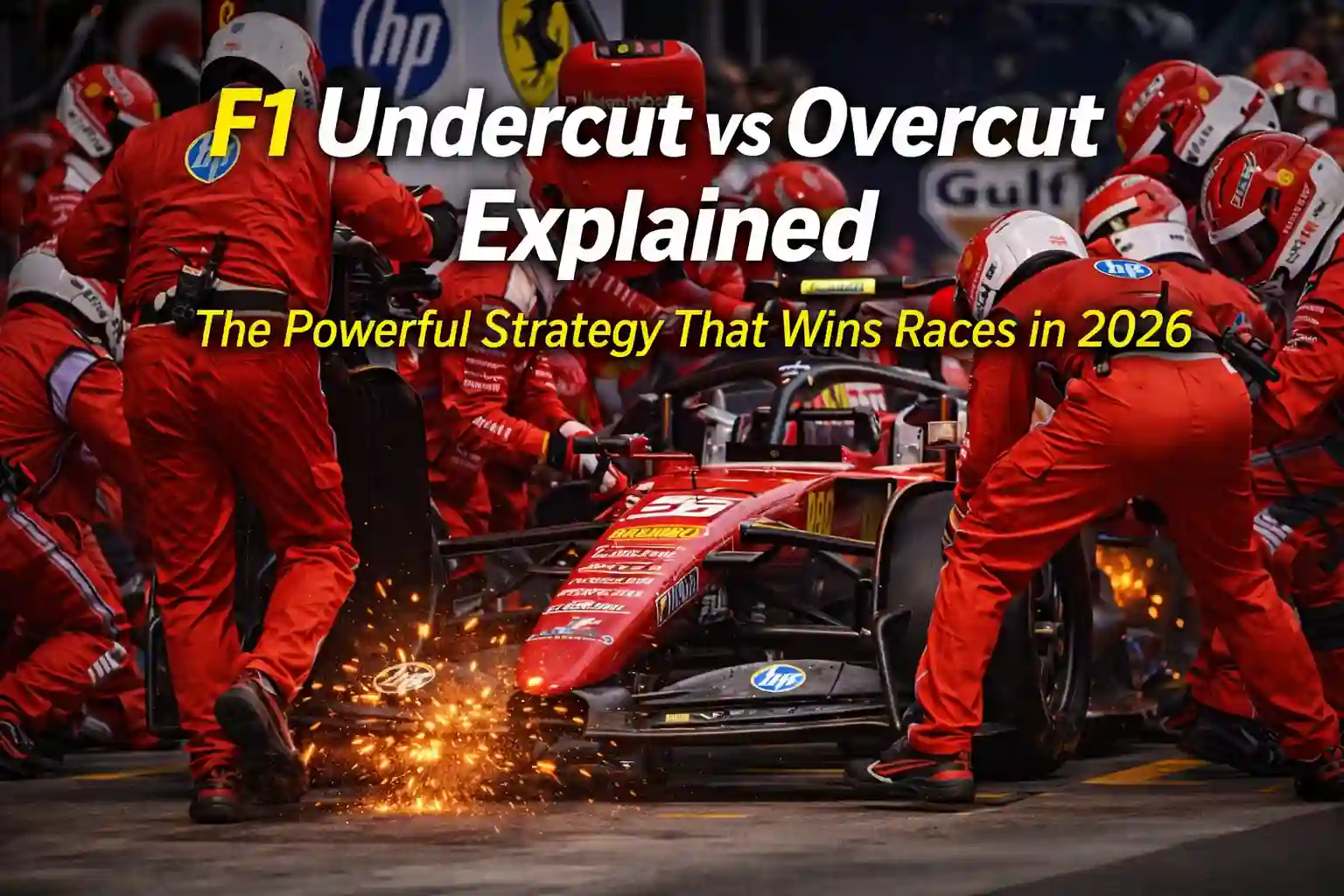
F1 undercut vs overcut has become one of the most decisive strategic battles in modern Formula 1, particularly under the 2026 regulations where overtaking remains difficult and track position is critical. With qualifying gaps often under 0.2 seconds, races are increasingly decided not by outright pace, but by how effectively teams manage pit stop timing, tire behavior, and clean air.
This technical deep dive delivers a data-driven F1 race strategy 2026 analysis, breaking down when each approach works, why the undercut has gained dominance, and how teams model these decisions in real time.
Defining the Strategies
Before analyzing performance, it’s essential to clearly define both approaches.
Undercut Strategy
- Pit earlier than your direct rival
- Switch to fresh tires
- Use immediate grip advantage to gain lap time
Overcut Strategy
- Stay out longer while rivals pit
- Extend stint on older tires
- Attempt to gain time while competitors manage out-lap limitations
At a surface level, both strategies seem balanced. In reality, their effectiveness is dictated by tire physics and race conditions.
Tire Performance: The Core Variable
Tires are the single most influential factor in determining whether an undercut or overcut succeeds.
Key Performance Metrics:
- Optimal temperature window: 95–110°C
- Peak grip phase: first 3–5 laps after pit stop
- Degradation onset: gradual → exponential
Undercut Advantage:
Fresh tires deliver:
- Immediate grip increase
- Better traction on corner exit
- Reduced braking distances
Quantified Gain:
- Out-lap delta: +1.5 to +2.0 seconds
- Net gain over 2 laps: +2.5 to +3.5 seconds
Embed from Getty Images
Tire Warm-Up: The Deciding Factor
In 2026, tire warm-up behavior has become more influential than peak grip itself.
Fast Warm-Up Compounds:
- Favor aggressive undercuts
- Deliver instant lap time gains
Slow Warm-Up Compounds:
- Reduce undercut effectiveness
- Open opportunity for overcut
Data Insight:
A 0.4–0.6 second warm-up deficit can completely negate an undercut advantage.
The Role of Dirty Air
Dirty air remains a critical strategic variable.
Impact on Performance:
- Downforce loss: 15–20%
- Tire temperature increase: +6–8°C
- Lap time loss: 0.2–0.4 seconds per lap
Strategic Implication:
- Undercut allows drivers to rejoin in clean air
- Overcut risks prolonged exposure to traffic
This is why clean air has become more valuable than raw pace.
Energy Deployment and Acceleration Advantage
Energy systems now directly influence pit strategy success.
Undercut Scenario:
- Fresh tires improve traction
- Better energy deployment efficiency
- Stronger acceleration out of corners
Overcut Scenario:
- Worn tires reduce traction
- Energy deployment less effective
- Slower lap times despite track position
Net Impact:
Energy and tire synergy heavily favors the undercut in most scenarios.
Embed from Getty Images
The Metrics: Undercut vs Overcut Comparison
| Metric | Undercut Strategy | Overcut Strategy |
|---|---|---|
| Out-Lap Pace | Very Fast | Slower |
| Tire Condition | Fresh | Degrading |
| Traffic Exposure | Low (clean air target) | High risk |
| Lap Time Gain Potential | +2.0–3.5s | +0.5–1.5s |
| Risk Level | Medium | Situational |
Case Study: Red Bull Racing vs Ferrari
Scenario:
Drivers separated by 1.3 seconds.
Strategy Call:
- Red Bull: Undercut
- Ferrari: Overcut
Outcome:
- Red Bull gains 2.4 seconds across two laps
- Successfully overtakes after pit cycle
Key Drivers:
- Faster tire warm-up
- Clean air advantage
- Stable energy deployment
When the Overcut Still Works
Despite undercut dominance, the overcut remains viable under specific conditions.
1. High Degradation Circuits
- Rivals lose performance quickly after pitting
2. Traffic Ahead of Undercutting Driver
- Fresh tires wasted in dirty air
3. Hard Compound Usage
- Longer warm-up phase reduces immediate gains
Pit Stop Delta and Timing Windows
The pit stop time loss in 2026 is typically:
- 20–25 seconds (track dependent)
This creates a narrow decision window.
Strategic Considerations:
- Gap to car behind
- Traffic density
- Tire condition relative to rivals
A poorly timed stop can negate all theoretical gains.
Why the Undercut Dominates in 2026
Several factors explain the increasing success rate of the undercut:
- Improved tire warm-up performance
- Persistent dirty air effects
- High importance of track position
- Energy deployment advantages
Statistical Insight:
- Approximately 65–70% of successful position gains occur via undercut strategies
Embed from Getty Images
Strategic Decision Model
Teams rely on real-time simulations using:
- Tire degradation curves
- Traffic prediction models
- Energy deployment mapping
- Lap time delta calculations
Simplified Rule Set:
- Fast warm-up + clean air → Undercut preferred
- Slow warm-up + traffic risk → Overcut viable
The Bigger Picture: Strategy Defines Outcomes
Modern Formula 1 has evolved into a discipline where:
- Strategy amplifies performance differences
- Tire management dictates race pace
- Clean air determines consistency
The fastest car does not always win—the best-executed strategy does.
Final Insight
F1 undercut vs overcut is no longer a balanced strategic choice. In 2026, the undercut has emerged as the more consistently effective approach, primarily due to tire behavior and aerodynamic constraints.
However, success still depends on execution. The teams that accurately predict tire performance, traffic evolution, and energy dynamics will continue to outperform rivals.
In today’s Formula 1, races are not just driven—they are calculated.
What is F1 undercut vs overcut?
F1 undercut vs overcut refers to two different pit stop strategies in Formula 1. The undercut involves pitting earlier to gain time on fresh tires, while the overcut involves staying out longer to gain track position.
Which strategy is better: undercut or overcut?
The undercut is generally more effective in modern Formula 1 due to faster tire warm-up and the importance of clean air. However, the overcut can work in specific situations like high tire degradation or traffic.
Why is the undercut so powerful in F1 2026?
The undercut is powerful because fresh tires provide immediate grip, allowing drivers to gain significant lap time—often 1.5 to 2 seconds on the out-lap—and potentially overtake rivals during pit cycles.
How does tire warm-up affect strategy?
Tire warm-up is critical. Faster warm-up allows drivers to maximize grip immediately after a pit stop, which is essential for a successful undercut.
How much time is lost during an F1 pit stop?
A typical pit stop results in a total time loss of around 20–25 seconds, depending on the track and pit lane length.
What role does dirty air play in strategy?
Dirty air reduces downforce and increases tire wear, making it harder to follow another car closely. This is why gaining track position through strategy is so important.
Do teams always prefer the undercut?
No. While the undercut is often preferred, teams evaluate multiple factors such as tire condition, traffic, and race pace before making a decision.
