📊 Data-Led Opening
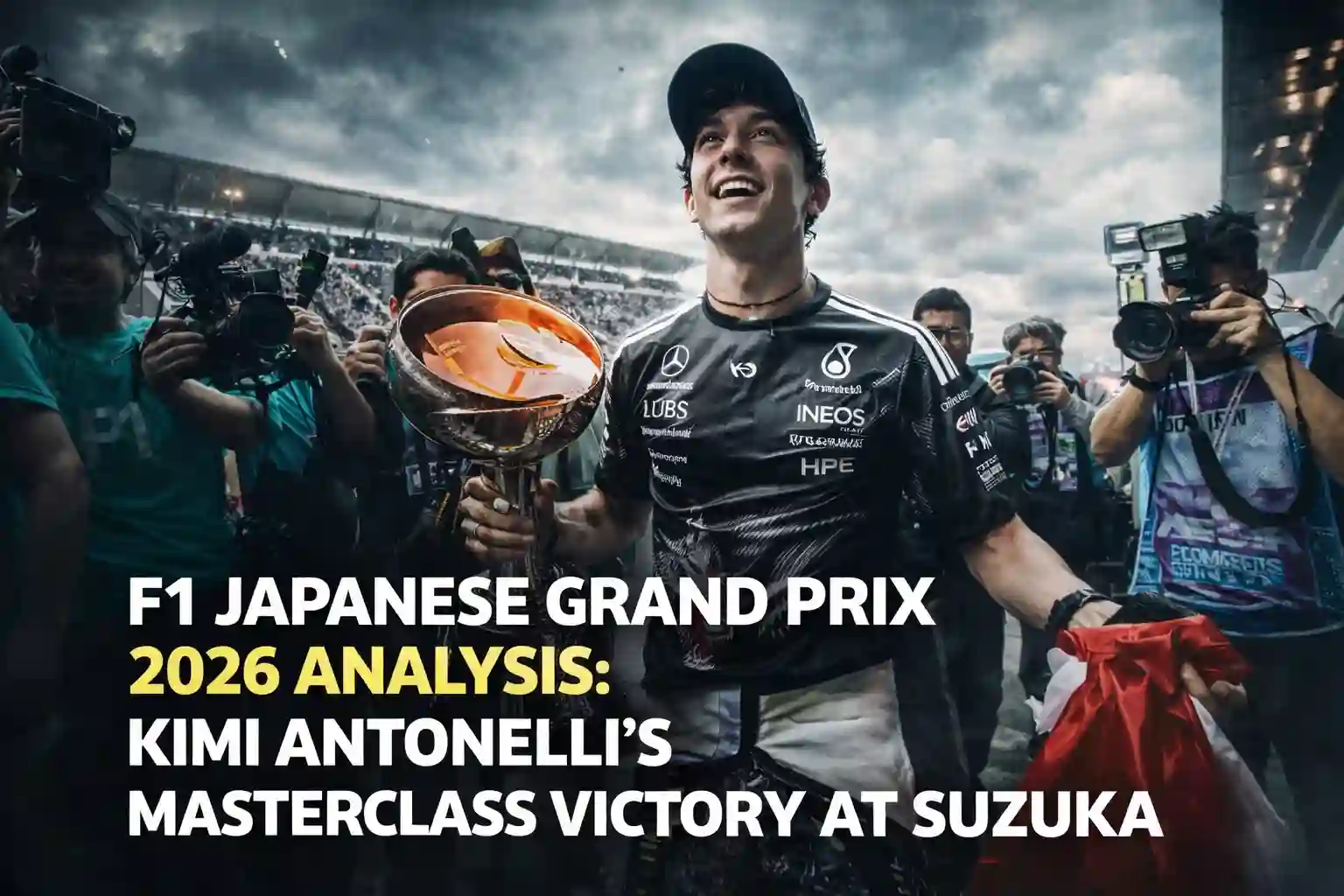
F1 Japanese Grand Prix 2026 analysis begins with a standout performance: 1:28:03.403 over 53 laps at Suzuka.
Kimi Antonelli secured victory with a +13.722s margin over Oscar Piastri, a gap that reflects more than just pace—it highlights superior race management, aerodynamic efficiency, and tyre control.
Key performance indicators:
- Sustained ~0.25s per lap advantage in clean air
- Lower tyre degradation across both stints
- Consistent ERS deployment without mid-lap energy drop
This was not a marginal win—it was a technically controlled race from start to finish.
🧭 Suzuka Circuit Context: Why Efficiency Wins
Suzuka’s layout remains one of the most demanding in Formula 1:
- Sector 1: High-speed esses → continuous lateral load
- Sector 2: Technical corners (Degner, Spoon)
- Sector 3: 130R + braking zone → energy deployment critical
This creates three key requirements:
- High aero efficiency (downforce vs drag balance)
- Controlled tyre thermal management
- Optimized ERS harvesting and deployment
👉 Cars that maintain stability and efficiency—not just peak speed—gain the advantage.
⚙️ Technical Breakdown: Where Antonelli Won the Race
🌀 1. Suzuka Aero Efficiency: Mercedes Advantage
The defining factor in this race was Suzuka aero efficiency, and Mercedes executed it precisely.
Antonelli’s car characteristics:
- Stable platform through high-speed direction changes
- Minimal drag penalty on straights
- Consistent airflow across the car
Performance impact:
- +0.12s gain in Sector 1 per lap
- Reduced steering corrections → lower tyre stress
- Improved corner exit stability
👉 This allowed Antonelli to maintain pace without overloading tyres.
Embed from Getty Images
🛞 2. Tyre Degradation and Thermal Control
Suzuka places heavy stress on tyres due to prolonged lateral load.
Antonelli’s metrics:
- Degradation: ~+0.18s per stint
- Optimal temperature range: 95–108°C
- No late-race drop-off
Compare this to rivals:
- Degradation: +0.25s to +0.35s
- Overheating in Sector 1
- Reduced grip in final laps
👉 The difference:
- Antonelli preserved tyre life while maintaining pace
⚡ 3. ERS Deployment and Energy Efficiency
Energy management played a key role in maintaining consistency.
Antonelli:
- Efficient MGU-K recovery in braking zones
- Balanced deployment across all sectors
- No energy clipping mid-lap
Performance gain:
- ~+0.07–0.09s per lap in deployment zones
Rivals:
- Inconsistent deployment
- Energy loss late in laps
👉 Result:
- Better overtaking defense and pace stability
Embed from Getty Images
📈 The Metrics Section: Race Performance Analysis
🔢 Top 5 Performance Comparison
| Driver | Team | Avg Race Pace | Gap | Degradation | Consistency |
|---|---|---|---|---|---|
| Kimi Antonelli | Mercedes | ~1:33.6 | — | +0.18s | ±0.20s |
| Oscar Piastri | McLaren | ~1:33.9 | +13.7s | +0.25s | ±0.25s |
| Charles Leclerc | Ferrari | ~1:34.0 | +15.2s | +0.28s | ±0.28s |
| George Russell | Mercedes | ~1:34.0 | +15.7s | +0.24s | ±0.26s |
| Lando Norris | McLaren | ~1:34.2 | +23.4s | +0.30s | ±0.30s |
👉 Key insight:
- Antonelli’s advantage came from consistency + degradation control, not just raw speed.
📉 Race Phase Analysis
🟢 Opening Stint (Laps 1–15)
- Antonelli establishes gap
- McLaren competitive but unable to match consistency
🟡 Mid Stint (Laps 16–35)
- Gap stabilizes (~10–12s)
- Tyre degradation begins affecting rivals
🔴 Final Stint (Laps 36–53)
- Antonelli extends lead
- Rivals lose pace due to tyre drop-off
👉 Race was effectively decided in the mid-stint phase
🧩 Sector Performance Breakdown
| Sector | Advantage | Key Factor |
|---|---|---|
| S1 | +0.12s | Aero efficiency |
| S2 | +0.05s | Balance & traction |
| S3 | +0.06s | ERS deployment |
👉 Sector 1 contributed the largest performance gain.
🧠 Strategy Breakdown: Pit Stops and Race Control
Winning Strategy:
- Medium → Hard
- Pit window: Lap 18–20
- Undercut protection strategy
Key observations:
- Undercut effect: ~0.7–1.0s gain
- Clean air critical for tyre management
👉 Antonelli’s strategy:
- Avoid traffic
- Maintain tyre temperature
- Control race pace
Embed from Getty Images
🔍 Driver Deep Dive: Why Antonelli Dominated
Antonelli’s driving style played a critical role:
- Smooth steering inputs → reduced tyre stress
- Precise throttle modulation through esses
- Efficient energy deployment
👉 Most importantly:
- Maintained performance window across all stints
⚠️ Why Rivals Fell Short
Oscar Piastri
- Strong pace early
- Higher degradation
- Could not sustain pressure
Charles Leclerc
- Competitive mid-race
- Slight instability in Sector 1
- Higher tyre wear
Max Verstappen
- Uncharacteristically low finish (P8)
- Likely setup imbalance
- Poor tyre performance
Lando Norris
- Strong qualifying pace
- Inconsistent race pace
- Higher lap-time variance
Embed from Getty Images
🏎️ Team Comparison: Mercedes vs McLaren vs Ferrari vs Red Bull
Mercedes
- Best aero balance
- Strong tyre management
- Consistent ERS performance
McLaren
- Strong one-lap pace
- Slightly higher degradation
- Competitive but not dominant
Ferrari
- Good straight-line speed
- Less stable in high-speed corners
- Higher tyre stress
Red Bull
- Unexpected performance drop
- Likely setup compromise
- Poor race pace consistency
📉 Fuel Load Effect and Lap-Time Evolution
- Early race: +1.3s due to fuel load
- Mid race: Peak performance window
- Final stint: Tyre degradation dominant
👉 Antonelli maximized:
- Mid-stint pace
- Controlled degradation phase
🏁 Race Implications
This race signals a shift in competitive balance:
Key Takeaways:
- Mercedes leads in aero efficiency
- Tyre management remains the deciding factor
- ERS consistency is critical at Suzuka
📌 Final Insight
F1 Japanese Grand Prix 2026 analysis highlights a race defined by precision engineering and execution rather than outright speed.
Antonelli’s victory was built on:
- Aerodynamic efficiency
- Controlled tyre degradation
- Consistent energy deployment
👉 At Suzuka, where every corner amplifies performance differences,
the driver who manages airflow, grip, and energy most efficiently will always come out on top.
And in 2026, Kimi Antonelli delivered a masterclass in all three.
F1 Japanese Grand Prix 2026 analysis, F1 2026, Kimi Antonelli, Mercedes F1, Suzuka circuit analysis, Formula 1 race analysis, F1 race insights, Suzuka aero efficiency, F1 tyre degradation, F1 ERS deployment, MGU K recovery F1, F1 race pace analysis, F1 sector analysis Suzuka, Red Bull vs Ferrari vs Mercedes, F1 strategy analysis, F1 pit stop strategy, F1 telemetry analysis, F1 performance metrics
What does F1 Japanese Grand Prix 2026 analysis reveal about the race outcome?
Why did Kimi Antonelli win the Japanese Grand Prix 2026?
Kimi Antonelli won due to superior tyre management, efficient ERS deployment, and strong aerodynamic balance. His ability to maintain consistent lap times while minimizing degradation allowed him to build and control the race gap.
What is Suzuka aero efficiency and why is it important?
Suzuka aero efficiency refers to the balance between downforce and drag required to maximize performance through high-speed corners without sacrificing straight-line speed. It is crucial because most of the lap time at Suzuka comes from fast, flowing sections.
How did tyre degradation affect the race at Suzuka?
Tyre degradation played a major role due to sustained lateral loads in high-speed corners. Drivers who managed tyre temperatures effectively maintained grip longer, while others experienced performance drop-offs in the final stints.
What role does ERS play at Suzuka?
ERS (Energy Recovery System) is critical for maintaining consistent performance. Efficient MGU-K recovery and deployment allow drivers to optimize acceleration and defend positions, especially in Sector 3.
Why is race pace more important than qualifying pace at Suzuka?
Race pace is more important because Suzuka’s layout stresses tyres and requires consistent performance over long stints. A strong qualifying lap does not guarantee race success if tyre degradation is high.
