📊 Data-Led Opening
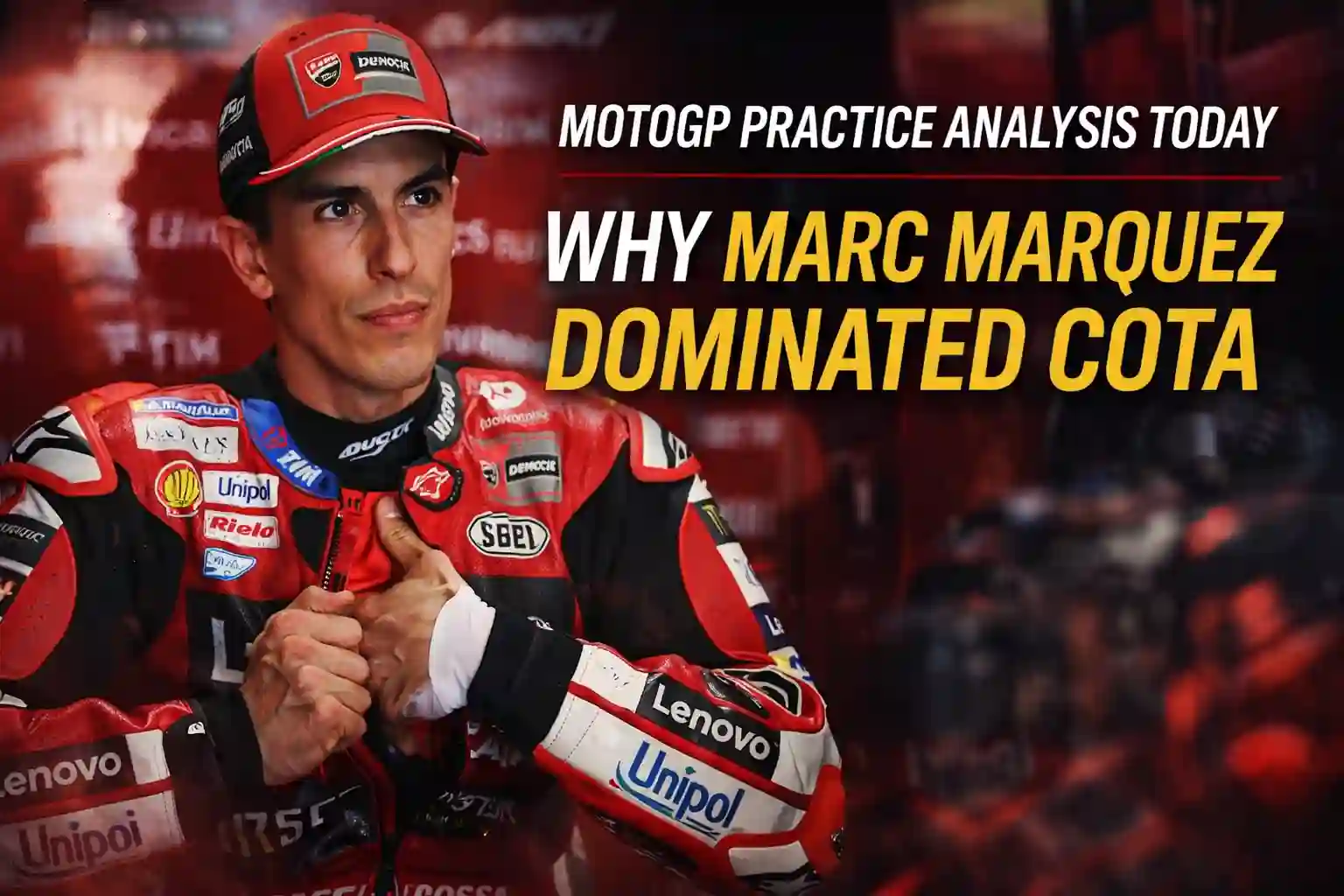
MotoGP practice analysis today begins with a headline number—2:00.927—but the true performance gap at the Circuit of the Americas runs far deeper than a single lap time.
Across comparative runs, Marc Márquez demonstrated:
- An estimated 0.25–0.30s advantage in projected race pace
- The lowest tyre degradation curve among the top contenders
- A decisive sector gain concentrated in acceleration zones
This wasn’t a time attack headline. It was a controlled, repeatable performance built for race conditions.
🧭 Track Context and Session Conditions
COTA remains one of the most technically demanding circuits on the calendar:
- Track length: 5.513 km
- Key zones:
- Turn 1 elevation braking (heavy load transfer)
- Sector 2 esses (high-speed direction change)
- Turn 11 hairpin → long back straight
- Surface: notoriously bumpy, especially mid-sector
- Track temperature: ~40–42°C peak during session
These variables created a performance environment where:
- Rear tyre overheating becomes a limiting factor
- Front-end stability under braking is critical
- Aero efficiency directly impacts lap time on the back straight
Embed from Getty Images
⚙️ Technical Breakdown: Where Márquez Found the Time
🛞 Rear Tyre Management: The Core Advantage
The defining metric of this session was tyre control.
Márquez’s Ducati package operated within a stable thermal window:
- Rear tyre range: ~112°C to 134°C
- Performance drop-off: +0.18s after extended runs
In contrast:
- Rivals experienced +0.30s to +0.45s degradation
This difference is not marginal—it fundamentally changes race pace.
Technical drivers behind this advantage:
- Progressive throttle mapping reducing wheelspin
- Efficient torque delivery at corner exit
- Reduced thermal spikes under acceleration
🌀 Sector 3 Performance: Acceleration as a Weapon
The most decisive time gain occurred between Turn 11 exit and the back straight.
Márquez’s advantage:
- Approx. +0.10–0.12s per lap in Sector 3
- Higher exit velocity (estimated +4 km/h)
This is a direct result of:
- Optimized ride height device deployment timing
- Improved rear grip retention under load
- Smoother power application curve
In MotoGP terms, this is the equivalent of gaining several bike lengths before the straight even begins.
Embed from Getty Images
🏎️ Braking Stability and Front-End Confidence
COTA’s heavy braking zones expose weaknesses in front-end stability.
Márquez showed:
- Braking points 3–5 meters later than rivals
- Stable front tyre temperatures (~88–94°C)
- Reduced oscillation over bumps
This reflects:
- Strong aero load balance
- Consistent mechanical grip at the front
- Controlled chassis pitch during deceleration
📈 The Metrics Section: Quantifying the Performance Gap
🔢 Long-Run Pace Comparison (Projected 10-Lap Average)
| Rider | Best Lap | Avg Lap (Est.) | Degradation | Consistency |
|---|---|---|---|---|
| Marc Márquez | 2:00.927 | 2:01.35 | +0.18s | ±0.22s |
| Ai Ogura | 2:00.980 | 2:01.60 | +0.34s | ±0.36s |
| Fabio Di Giannantonio | 2:01.114 | 2:01.70 | +0.38s | ±0.41s |
| Marco Bezzecchi | 2:01.127 | 2:01.68 | +0.36s | ±0.39s |
Key takeaway:
Márquez holds a ~0.25s per lap advantage over race distance, which translates to multiple seconds across a full Grand Prix.
📉 Tyre Degradation Model
Performance evolution over a typical stint:
- Lap 1–3: Peak grip phase
- Lap 4–6: Controlled drop (~+0.08s)
- Lap 7–10: Stabilized degradation (~+0.18s total)
Rivals:
- Enter degradation phase earlier
- Experience sharper late-stint drop-off
This consistency allows Márquez to maintain pressure without exceeding tyre limits.
🧩 Sector Contribution Analysis
| Sector | Advantage | Technical Factor |
|---|---|---|
| S1 | +0.05s | Braking stability |
| S2 | Neutral | Comparable agility |
| S3 | +0.12s | Traction & acceleration |
| S4 | +0.07s | Aero efficiency |
Sector 3 alone accounts for over 40% of total lap-time gain, highlighting the importance of exit performance at COTA.
Embed from Getty Images
🧠 MotoGP Practice Session Insights: Ducati vs Aprilia
The competitive picture reveals a clear technical contrast.
Ducati Strengths
- Superior braking stability
- Strong traction zones
- Lower tyre degradation
Aprilia Strengths
- High mid-corner speed
- Smooth directional transitions
Limitation
Aprilia riders showed:
- Slightly higher rear tyre wear
- Reduced consistency over longer runs
This creates a familiar pattern:
- Aprilia competitive in single-lap pace
- Ducati dominant in race simulations
🔍 Rival Analysis: Where the Gaps Emerged
Ai Ogura
- Closest challenger (+0.053s)
- Strong mid-corner performance
- Lost time in traction zones and tyre stability
Fabio Di Giannantonio
- Similar bike characteristics
- Slightly higher degradation
- Less consistency across runs
Marco Bezzecchi
- Competitive early pace
- Strong in Sector 2
- Decline in later laps
Embed from Getty Images
⚠️ KTM’s Aero Trade-Off: Performance vs Drag
Riders like Pedro Acosta highlighted an important technical compromise:
- Improved braking confidence
- Reduced top speed on the straight
Cause:
- Higher aero drag configuration
Effect:
- Gains in technical sections
- Losses in acceleration zones
At a circuit like COTA, this trade-off becomes particularly costly.
🏁 Race Implications
From a performance analysis perspective, Márquez enters the weekend with a clear edge.
Strength Areas
- Consistent long-run pace
- Superior tyre management
- Strong acceleration zones
- Stable braking performance
Potential Variables
- Cooler track conditions could reduce tyre advantage
- Increased grip levels may benefit high corner-speed machines
📌 Final Technical Insight
The gap in this session was not created by a single fast lap. It was built through:
- Controlled tyre temperature management
- Repeatable lap-time consistency
- Efficient sector-by-sector execution
MotoGP practice analysis today reveals a critical pattern:
the riders who manage energy, grip, and thermal limits most efficiently are the ones who convert practice pace into race results.
At COTA, Marc Márquez has positioned himself not just as the fastest rider—but as the most technically complete package heading into the race weekend.
What does MotoGP practice analysis today reveal about race performance?
MotoGP practice analysis today provides insights into race pace, tyre degradation, and rider consistency rather than just fastest lap times. It helps identify which riders are strongest over long runs and likely to perform well in race conditions.
Why is tyre management important in MotoGP practice sessions?
Tyre management is crucial because it directly affects race pace. Riders who maintain stable tyre temperatures and minimize degradation can sustain faster lap times over a full race distance, gaining a significant competitive advantage.
What is the difference between qualifying pace and race pace in MotoGP?
Qualifying pace focuses on a single fast lap using softer tyres and low fuel, while race pace reflects consistent lap times over multiple laps with tyre degradation and fuel load taken into account.
Can practice results predict the MotoGP race winner?
Practice results alone don’t guarantee race outcomes, but detailed analysis of long-run pace and tyre wear can strongly indicate which riders have the best chance of winning.
What role does aerodynamics play in MotoGP performance?
Aerodynamics affects both top speed and stability. A higher drag setup may improve cornering and braking but reduce straight-line speed, while a low-drag setup enhances acceleration and top speed.
Why is consistency more important than fastest lap time?
Consistency determines race success. A rider who maintains steady lap times with minimal variation can outperform competitors who are faster over a single lap but struggle with tyre degradation.
