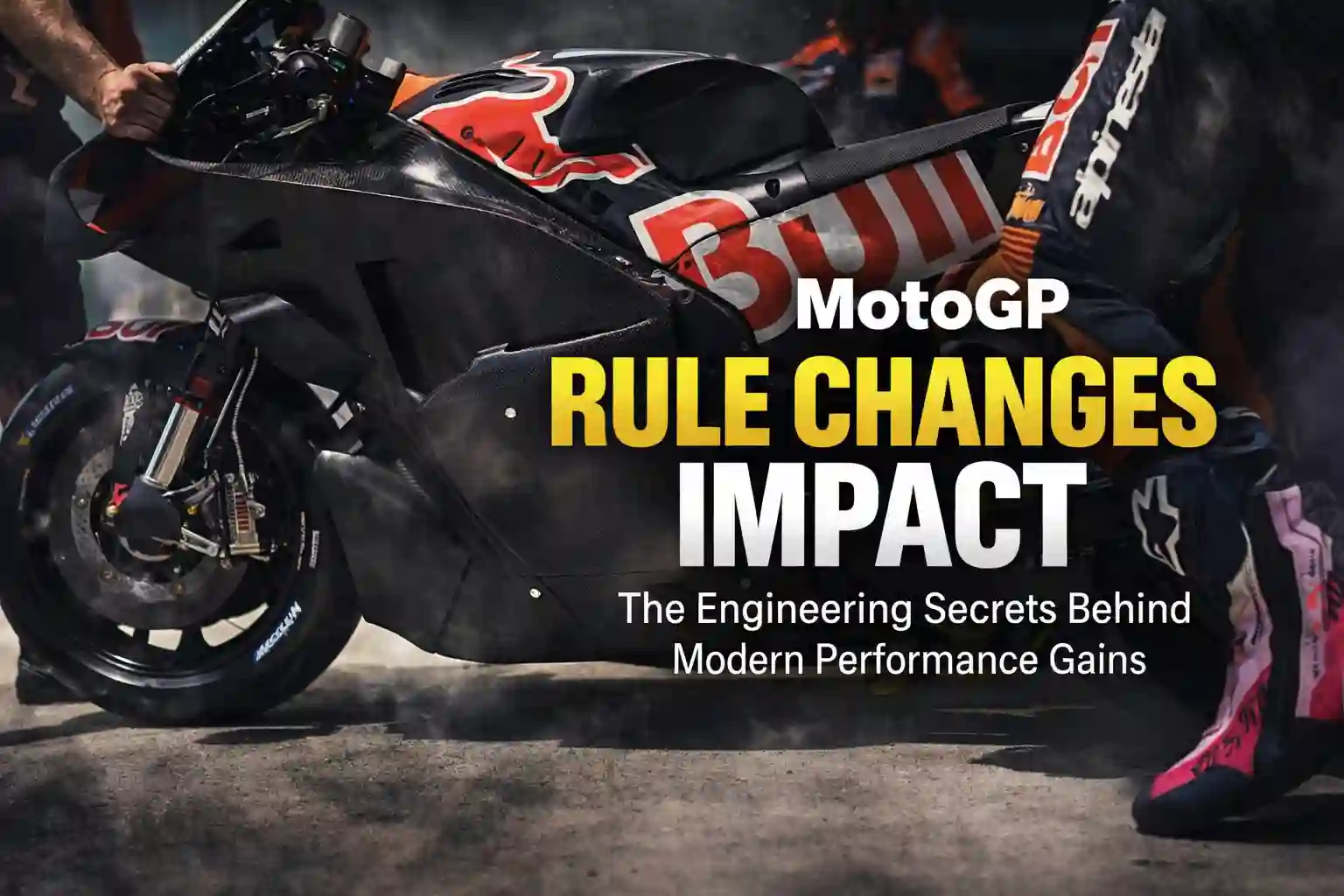
MotoGP rule changes impact is best measured not in headlines, but in tenths of a second. Since 2016, a sequence of regulatory resets—most notably spec electronics, aerodynamic liberalization, and mechanical ride-height systems—has reshaped the competitive hierarchy. The result is a grid that appears closer on paper, yet is fundamentally defined by how well each manufacturer has engineered around constraints.
This analysis breaks down the physics, data, and design philosophy behind that shift—focusing on why some factories surged while others struggled to adapt.
The 2016 Reset: Spec ECU and Unified Software
The introduction of a standardized ECU and software platform from Magneti Marelli marked a decisive turning point. It removed one of the biggest competitive differentiators: bespoke electronic rider aids.
What Changed Technically
- Unified traction control algorithms
- Standard torque demand mapping
- Restricted engine-braking customization
- Limited real-time adaptive strategies
Performance Consequences
Manufacturers that previously relied on sophisticated electronics—particularly Yamaha Factory Racing and Repsol Honda Team—lost a critical advantage. Their bikes had been designed around smooth electronic intervention to manage corner entry and exit stability.
In contrast, Ducati Corse gained immediate ground. Without needing to compete in software complexity, Ducati’s strengths—engine power, mechanical grip, and stability—became more influential.
Engineering Interpretation
With reduced electronic smoothing, torque delivery became a mechanical problem rather than a software one. This favored bikes with:
- Longer wheelbases
- Rearward weight bias
- Predictable torque curves
Ducati’s Desmosedici platform already aligned with these characteristics, allowing it to exploit the regulation more effectively.
Embed from Getty Images
MotoGP Aero and Ride Height Devices: A New Performance Axis
The secondary wave of transformation came through MotoGP aero and ride height devices, fundamentally altering acceleration dynamics and load transfer behavior.
Aerodynamic Evolution
Modern MotoGP aerodynamics is centered on front-end load generation. Winglets produce downforce that increases tire grip under acceleration and braking.
Measurable Gains:
- Reduced wheelie → earlier throttle application
- Increased braking stability → shorter stopping distances
- Improved high-speed corner control
However, these gains come with trade-offs:
- Increased aerodynamic drag
- Reduced agility in direction changes
Ride Height Devices: Mechanical Innovation
Ride height devices—first introduced by Ducati—lower the bike during acceleration phases.
Key Effects:
- Lower center of gravity
- Reduced wheelie tendency
- Increased rear tire contact efficiency
Data Insight:
- Launch phase gain: ~0.12–0.18 seconds
- Corner exit improvement: ~0.1 seconds per major acceleration zone
- Total lap gain: up to 0.4 seconds
Manufacturer Adaptation
- Ducati: Fully integrated aero + ride height philosophy
- Aprilia: Balanced system with strong chassis harmony
- KTM: High peak performance, narrow setup window
- Yamaha: Struggled due to reliance on corner speed
- Honda: Inconsistent due to unstable base platform
Tire Behavior: The Michelin Variable
Since Michelin became the sole supplier, tire characteristics have become a defining constraint.
Critical Parameters
- Narrow front tire temperature window
- Rear tire overheating sensitivity
- Peak performance within ~90–110°C carcass range
Thermal Degradation Metrics
| Condition | Temperature | Lap Time Effect |
|---|---|---|
| Optimal | 95–105°C | Maximum grip |
| Slight Overheat | 110°C | +0.05s loss |
| Severe Overheat | 115°C+ | +0.1–0.2s loss |
Manufacturer Outcomes
Ducati’s strength lies in controlled torque delivery, reducing wheelspin and thermal spikes. Yamaha, by contrast, pushes higher corner speed, which stresses the front tire and leads to inconsistency over race distance.
Embed from Getty Images
The Metrics Section: Lap Time Decomposition
To understand how these rule changes translate into performance, consider a representative 5.4 km circuit.
Sector-by-Sector Comparison
| Sector Type | Ducati Advantage | Primary Factor |
|---|---|---|
| Acceleration Zones | +0.17s | Ride height + traction |
| Heavy Braking | +0.06s | Aero stability |
| High-Speed Corners | +0.04s | Downforce |
| Flowing Sections | -0.03s | Yamaha agility |
| Total Lap Delta | +0.24s | Net advantage |
Torque Delivery and Energy Management
With electronics standardized, manufacturers shifted toward mechanical torque shaping.
Ducati Approach
- Linear torque curve
- High crankshaft inertia
- Stable rear grip under load
Yamaha Approach
- High corner speed strategy
- Aggressive throttle pickup
- Increased rear tire stress
Result
The inability to finely tune torque electronically means that energy delivery must be inherently stable. Ducati’s approach minimizes sudden load spikes, preserving tire performance over race distance.
Why Some Manufacturers Fell Behind
The modern MotoGP landscape rewards system integration, not isolated excellence.
Yamaha’s Challenge
- Built around corner speed philosophy
- Struggles with rear grip and acceleration
- Aero limitations reduce adaptability
Honda’s Instability
- Historically relied on braking dominance
- Current platform lacks balance
- Difficult for riders to extract consistent performance
KTM & Aprilia: The New Contenders
- Rapid adaptation to aero concepts
- Strong mechanical grip focus
- Competitive but not yet as refined as Ducati
Comparative Performance Snapshot
| Parameter | Ducati | Yamaha | Honda | KTM | Aprilia |
|---|---|---|---|---|---|
| Acceleration | 10/10 | 7/10 | 8/10 | 9/10 | 9/10 |
| Braking Stability | 9/10 | 8/10 | 6/10 | 8/10 | 8/10 |
| Corner Speed | 8/10 | 10/10 | 7/10 | 7/10 | 8/10 |
| Tire Management | 9/10 | 7/10 | 6/10 | 8/10 | 8/10 |
| Aero Efficiency | 10/10 | 6/10 | 7/10 | 8/10 | 9/10 |
Embed from Getty Images
The Strategic Shift: From Electronics to Physics
The deeper story behind the MotoGP rule changes impact is a philosophical one. Performance is no longer dominated by hidden software advantages but by how effectively a manufacturer can manage:
- Load transfer
- Tire temperature
- Aerodynamic balance
- Mechanical grip
This shift has elevated engineering fundamentals over electronic complexity.
What the Data Really Shows
Across multiple circuits, the same pattern emerges:
- Ducati gains most in acceleration zones
- Yamaha remains competitive only in flowing sectors
- Honda’s performance fluctuates due to instability
The average lap time advantage of ~0.2–0.3 seconds is not derived from a single innovation, but from compounded marginal gains across multiple systems.
The New MotoGP Design Blueprint
To succeed under current regulations, a competitive MotoGP bike must:
- Generate consistent rear grip without electronic reliance
- Use aerodynamics to stabilize acceleration and braking
- Maintain tire temperature within a narrow performance window
- Integrate ride height systems seamlessly
Ducati is currently the only manufacturer that has optimized all four simultaneously.
Final Insight: Regulation as a Performance Multiplier
The modern MotoGP era demonstrates that regulations do not simply limit performance—they redirect it. The teams that interpret rules as engineering opportunities rather than constraints are the ones that rise to the top.
Understanding the MotoGP rule changes impact requires looking beyond race results and into the physics of performance. The stopwatch reflects what happens on track, but the real story is written in design philosophy, thermal efficiency, and mechanical precision.
And right now, that story is being led by those who adapted fastest..
What is the MotoGP rule changes impact on bike performance?
The MotoGP rule changes impact bike performance by shifting the focus from advanced electronics to mechanical grip, aerodynamics, and tire management. Standardized ECUs and evolving aero rules have forced manufacturers to redesign their bikes for stability, acceleration, and efficiency.
Why did Ducati benefit the most from MotoGP rule changes?
Ducati adapted quickly by focusing on mechanical grip, aerodynamic downforce, and ride height devices. These innovations improved acceleration and tire management, giving them a consistent advantage across different circuits.
What role does the spec ECU play in MotoGP performance?
The spec ECU limits electronic rider aids such as traction control and engine braking customization. This means performance now depends more on mechanical setup and bike design rather than software advantages.
How have MotoGP rule changes affected Yamaha and Honda?
The MotoGP rule changes impact Yamaha and Honda by reducing their traditional strengths. Yamaha’s reliance on smooth electronics and corner speed has been challenged, while Honda has struggled with stability and consistency under the new technical framework.
Why are MotoGP tires so important under current rules?
With limited electronic intervention, tire performance has become critical. Maintaining optimal temperature and minimizing degradation directly affects lap time, making tire management a key performance factor.
What is the biggest technical shift in modern MotoGP?
The biggest shift is the move from electronics-driven performance to physics-based engineering. Aerodynamics, load transfer, and mechanical grip now play a larger role than ever before.
Are MotoGP bikes faster after rule changes?
Yes, but in a different way. While top speeds may not have dramatically increased, improvements in acceleration, braking stability, and consistency have reduced lap times overall.
