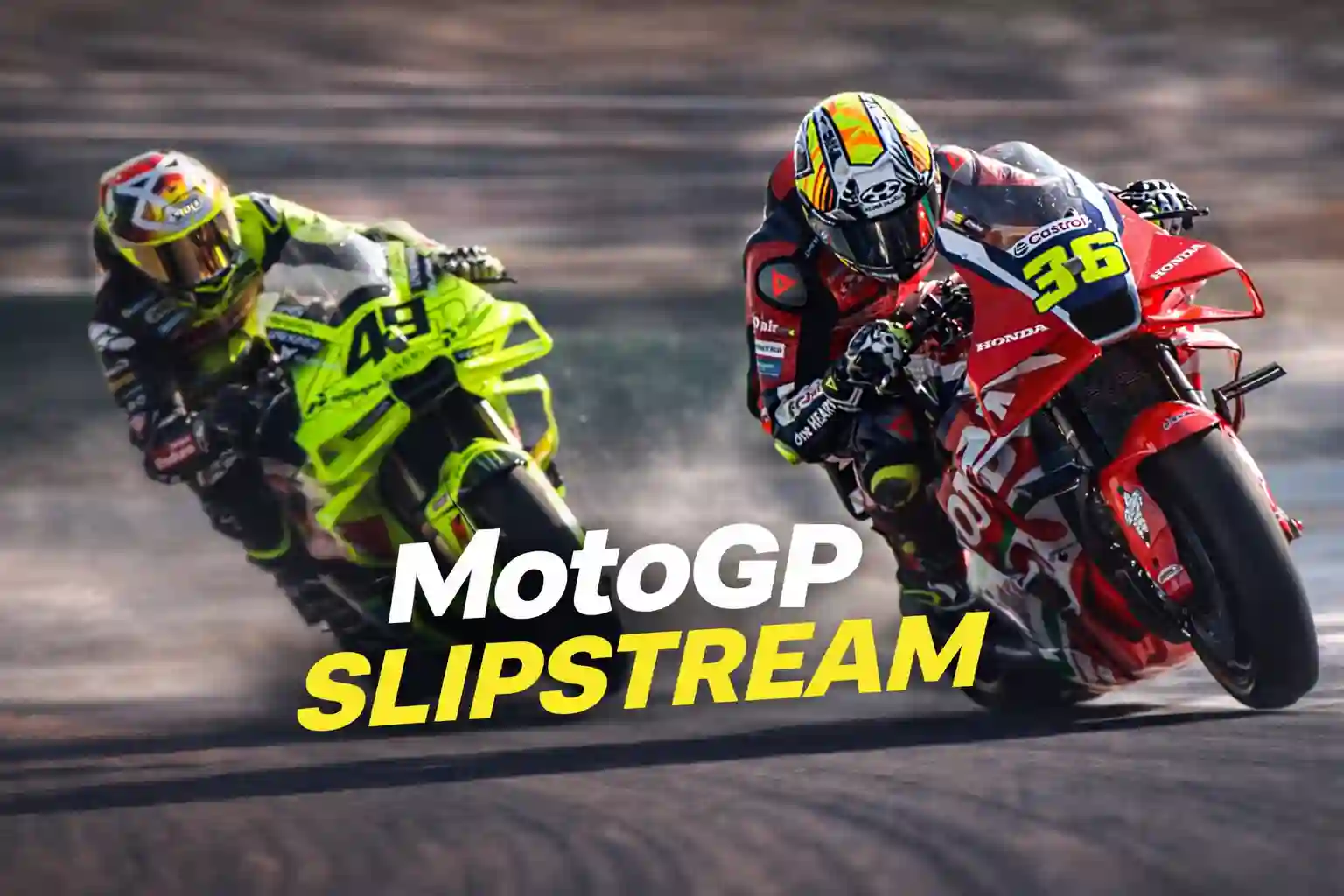
MotoGP slipstream is one of the most decisive aerodynamic advantages in modern motorcycle racing. On circuits where bikes exceed 350 km/h, the battle against aerodynamic drag becomes the defining performance factor. When one rider follows closely behind another, they enter a region of disturbed air where drag is significantly reduced. The result is simple but powerful: more speed without additional engine power.
This aerodynamic phenomenon—commonly known as drafting—is responsible for many of the dramatic last-second overtakes seen in MotoGP. On long straights like Mugello’s famous main straight, riders routinely gain 5–10 km/h simply by positioning their bike in the wake of another machine before launching an overtake.
Understanding what is slipstream effect in MotoGP requires examining the physics of airflow, motorcycle aerodynamics, and race strategy that combine to create one of motorsport’s most fascinating tactical tools.
Understanding the Slipstream Effect in MotoGP
The slipstream effect occurs when a trailing motorcycle rides inside the turbulent wake created by the bike ahead. As the leading machine cuts through the air, it leaves behind a region of lower pressure and reduced aerodynamic resistance.
For the rider behind, this disturbed airflow means:
- Reduced aerodynamic drag
- Lower engine load required to maintain speed
- Faster acceleration at the end of a straight
This aerodynamic advantage becomes particularly important in MotoGP because motorcycles have extremely high power-to-weight ratios but relatively small frontal areas. As speeds increase, air resistance quickly becomes the dominant force acting against the bike.
In simple terms, the leading rider acts as an aerodynamic shield, allowing the trailing rider to move through air that has already been displaced.
Embed from Getty Images
The Physics Behind Motorcycle Drafting
At high speed, motorcycles must overcome aerodynamic drag, which increases rapidly as velocity rises. The drag force acting on a MotoGP bike can be described by the aerodynamic drag equation:Fd=21ρCdAv2
Where:
- Fd = drag force
- ρ = air density
- Cd = drag coefficient
- A = frontal area of the bike and rider
- v = velocity
The key factor here is that drag increases with the square of velocity. If a motorcycle doubles its speed, aerodynamic drag increases by four times.
At around 300–360 km/h, a MotoGP engine spends a significant portion of its power simply pushing air out of the way. When a rider sits in the wake of another motorcycle, the effective drag is reduced, allowing the trailing rider to gain additional speed.
How Riders Use the Slipstream During a Race
In race conditions, drafting is rarely accidental. Experienced riders deliberately position themselves to maximize aerodynamic advantage before executing an overtake.
Typical Slipstream Overtake Sequence
- Close the gap on corner exit
Riders accelerate aggressively out of the preceding corner to position themselves behind the leading bike. - Stay tucked behind the rival bike
Riders reduce their own frontal area by crouching low behind the windscreen. - Allow the aerodynamic gain to build
As the straight continues, the trailing rider gradually gains speed. - Pull out at the final moment
The overtake attempt typically begins 150–200 meters before the braking zone. - Brake later into the corner
The rider uses the additional speed to complete the pass before the next turn.
Timing is critical. Pulling out of the wake too early exposes the rider to clean air, instantly removing the aerodynamic advantage.
How Much Speed Can Slipstreaming Add?
The performance gain from drafting varies depending on the track and straight length. However, telemetry data from MotoGP races shows that the effect can be substantial.
| Scenario | Top Speed |
|---|---|
| Leading bike in clean air | 350 km/h |
| Rider running alone | 350 km/h |
| Rider in aerodynamic wake | 355–360 km/h |
On high-speed circuits such as Mugello and Qatar, these gains can be even greater. The extra velocity is often enough to transform a small gap into a decisive overtaking opportunity.
Embed from Getty Images
Why Slipstreaming Matters in MotoGP Qualifying
Drafting is not only useful during races. In qualifying sessions, riders frequently attempt to catch another competitor on track in order to benefit from aerodynamic assistance.
A well-timed tow can improve lap time by 0.2 to 0.4 seconds—a significant margin in a sport where pole position may be decided by thousandths of a second.
Because of this advantage, qualifying sessions often feature riders slowing on their out-lap to strategically position themselves behind another bike. While effective, the tactic can sometimes create congestion on track.
The Role of Aerodynamics in Modern MotoGP
MotoGP engineering has evolved dramatically over the past decade, particularly in the area of aerodynamics. Modern machines use sophisticated aerodynamic components that influence how the slipstream behaves.
Winglets
Winglets generate aerodynamic downforce, helping stabilize the motorcycle during acceleration and braking.
However, these devices also create:
- Additional turbulence behind the bike
- A more pronounced aerodynamic wake
This means the rider behind can experience an even stronger drafting effect, especially on long straights.
Ride-Height Devices
Ride-height devices lower the rear or front of the motorcycle during acceleration. By reducing the bike’s ride height, engineers achieve:
- Lower aerodynamic drag
- Improved stability
- Faster acceleration
Although these systems slightly reduce drag for the leading rider, they do not eliminate the slipstream effect entirely.
Tracks Where Slipstream Battles Are Most Common
Certain circuits amplify the aerodynamic benefits of drafting due to their layout and straight lengths.
High Slipstream Impact Tracks
- Mugello Circuit – One of the longest straights in MotoGP
- Losail International Circuit – Long main straight encourages drafting battles
- Red Bull Ring – Multiple heavy braking zones after long straights
- Phillip Island – High-speed sections create drafting trains
Lower Impact Tracks
Shorter circuits with tighter corners reduce the effectiveness of drafting.
Examples include:
- Sachsenring
- Valencia
- Jerez
At these venues, corner speed and braking performance play a greater role in overtaking.
Embed from Getty Images
Strategic Risks of Riding in the Slipstream
While drafting offers performance advantages, it also introduces several risks for riders.
Reduced Visibility
When following closely behind another bike, the trailing rider may struggle to see braking markers or track reference points.
Turbulent Airflow
The disturbed air behind a motorcycle can cause instability in the front end of the trailing bike. Riders sometimes experience helmet buffeting or reduced aerodynamic stability when riding too closely in the wake.
Higher Closing Speeds
Exiting the slipstream often results in a significant increase in speed relative to the leading bike. This can make braking zones more demanding and increase the likelihood of late braking mistakes.
Why Leading Riders Are Vulnerable on Long Straights
In a drafting scenario, the leading rider has no aerodynamic protection because they are running in clean air. This creates an interesting tactical dilemma during the closing laps of a race.
If a rider leads too early on a long straight, they risk being overtaken just before the braking zone. As a result, experienced competitors often attempt to remain second in the final corners before a long straight, using the aerodynamic advantage to attack at the last possible moment.
This dynamic explains why some MotoGP races feature multiple lead changes within the final lap.
The Future of Aerodynamics and Drafting in MotoGP
MotoGP aerodynamics continue to evolve as manufacturers search for performance gains through airflow management. New wing designs and aerodynamic fairings aim to increase stability and cornering performance.
However, these developments also influence how air flows behind the bike. More complex aerodynamic packages can produce stronger turbulent wakes, potentially making drafting even more pronounced on long straights.
Balancing aerodynamic development with close racing remains one of the key challenges for the championship’s technical regulations.
Why Slipstreaming Remains a Defining Element of MotoGP Racing
Understanding what is slipstream effect in MotoGP reveals why drafting plays such a central role in race strategy. The interaction between aerodynamic drag, engine power, and rider positioning creates a constant tactical battle on the straights.
For riders, mastering the technique requires precise timing, spatial awareness, and confidence in heavy braking zones. For engineers, it represents a complex aerodynamic puzzle that continues to shape motorcycle design.
Whether during qualifying laps or last-lap battles, the aerodynamic wake created by a leading motorcycle ensures that the fight for position remains unpredictable until the very end of the straight.
What is slipstream effect in MotoGP?
The slipstream effect in MotoGP occurs when a rider follows closely behind another motorcycle and rides in the disturbed air created by the leading bike. This reduces aerodynamic drag and allows the trailing rider to accelerate faster and reach a higher top speed on straights.
How does MotoGP slipstream help riders go faster?
MotoGP slipstream helps riders go faster by reducing air resistance. When a rider sits directly behind another motorcycle, the leading bike breaks the airflow first, creating a low-pressure wake. The trailing rider experiences less drag and can gain several kilometers per hour in top speed.
How much speed can slipstream add in MotoGP?
Slipstreaming can add approximately 5–10 km/h depending on the track and straight length. On high-speed circuits like Mugello or Qatar, riders can sometimes exceed 360 km/h when benefiting from aerodynamic drafting.
Why do MotoGP riders wait for another rider during qualifying?
During qualifying sessions, riders often wait for another motorcycle to appear ahead on track so they can benefit from a slipstream. A well-timed aerodynamic tow can improve lap times by 0.2 to 0.4 seconds, which can make a major difference in grid position.
Does slipstreaming make overtaking easier in MotoGP?
Yes. Slipstreaming creates a speed advantage that allows riders to close gaps quickly on long straights. Many overtakes occur just before braking zones, where the trailing rider uses the extra speed gained from the slipstream to pass the competitor ahead.
Can the leading rider defend against slipstream overtakes?
The leading rider has limited defense against slipstream overtakes because they are running in clean air and cannot benefit from aerodynamic drafting. Riders often try to delay overtakes until the braking zone or adjust their racing line to reduce the effectiveness of the slipstream.
Do MotoGP winglets affect slipstreaming?
Modern MotoGP bikes use aerodynamic winglets to improve stability and downforce. These winglets can increase turbulence behind the motorcycle, which sometimes strengthens the aerodynamic wake and slightly enhances the slipstream effect for the rider behind.
